COMPRESSION PRESSURE CHECK
| 1.Before inspection, set the vehicle to the pre-inspection condition. |
| 2.Disconnect the connector of the ignition coil, and then remove all of the ignition
coils and spark plugs. |
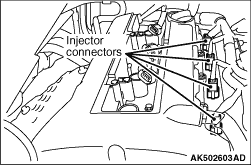 |
3.Disconnect all of the injector connectors.
|
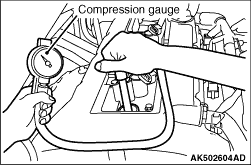 |
5.Set compression gauge to one of the spark plug holes. 6.Cranking the engine with the accelerator pedal fully depressed, measure the compression pressure. Standard value (at engine speed of 200 r/min):
1,470 kPa <4B11>
Minimum 1,050 kPa <4B11> Limit: Maximum 100 kPa 8.If there is a cylinder with compression or a compression difference that is outside the limit, pour a small amount of engine oil through the spark plug hole, and repeat the operations in steps from 5 to 7. (1) If the compression increases after oil is added, the cause of the malfunction is a worn or damaged piston ring and/or cylinder inner surface. (2) If the compression does not rise after oil is added, the cause is a burnt or defective valve seat, or pressure is leaking from the gasket. 9.Connect all of the injector connectors. 10.Install the spark plugs and spark plug cables. |
  |
11.Use the M.U.T.-III to erase the diagnosis codes.
|