|
|
1.Check that the cable, the regular charging plug and the plug do not have damage, corrosion
or rust. If they have damage, corrosion or rust, replace the charging cable.
|
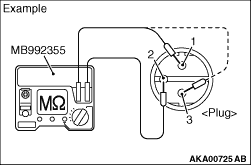
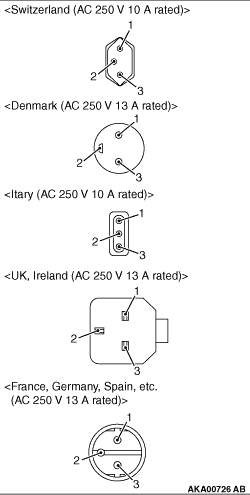
|
1. Use the special tool electric insulation tester (MB992355) to measure the insulation
resistance at the plug side with the range of 500 V.
| note |
The plug shape is different depending on the country. Perform the check according to the
specification of each country, referring to the illustration.
|
|
|
Standard value:
Tester connection terminal
|
Standard value
|
1 - 2
|
1 MΩ or more
|
2 - 3
|
1 MΩ or more
|
|
|
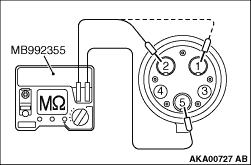
|
2. Use the special tool electric insulation tester (MB992355) to measure the insulation
resistance at the regular charging plug side with the range of 500 V.
|
|
Standard value:
Tester connection terminal
|
Standard value
|
1 - 5
|
1 MΩ or more
|
2 - 5
|
1 MΩ or more
|
|
3.If the resistance deviates from the standard value, replace the charging cable.
|

|
1.Measure the resistance between the regular charging plug terminal No. 4 and the terminal
No. 5.
|
|
standard value:
Regular charging plug release button
|
Normal condition
|
Without pressing release button
|
135 - 145 Ω (at 20°C)
|
With pressing release button
|
432 - 528 Ω (at 20°C)
|
|
2.If the resistance deviates from the standard value, replace the charging cable.
|

|
1.Connect the charging cable with a home socket.
2.Use the analogue voltmeter from the regular charging plug side to connect the pilot
signal terminal between the terminal No. 3 and the terminal No. 5. Measure the output voltage.
Standard value: approximately 12 V
3.If the voltage deviates from the standard value, replace the charging cable.
|