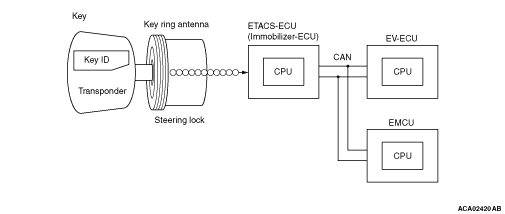
Component name
|
Outline of function
|
Transponder
|
Is power-supplied by the key ring antenna. When the transponder receives random number data, the transponder processes random number data and the encrypted code. Then it transmits the process result to the ETACS-ECU.
|
Key ring antenna
|
The ETACS-ECU supplies power via an antenna on a steering lock by transmission of electromagnetic waves to a transponder built into a key, using magnetic coupling
|
ETACS-ECU (Immobilizer-ECU)
|
- Supplies electrical power to the transponder integrated in the key, and transmits random number data.
- Verifies the key ID which is sent from the transponder. If the ID is correct, it sends an electric motor mobilization signal to the EV-ECU.
|
EV-ECU
|
Communicates with ETACS-ECU via CAN when the electric motor switch is turned ON and permits/stops the vehicle integrated control.
|
EMCU
|
Communicates with the EV-ECU via CAN to enable or disable the electric motor to be started.
|