|
|
Q.
Is any other diagnosis code than P0093 set?
|
|
|
 Inspection chart for diagnosis codes (Refer to Inspection chart for diagnosis codes (Refer to  ). ).
|
|
|
|
|
|
- Check whether fuel is leaking from a high-pressure fuel line.
|
|
|
Q.
Is the check result normal?
|
|
|
 Replace the parts of an abnormal location. Replace the parts of an abnormal location.
|
|
|
|
|
|
- After releasing the air from the fuel line, continue idle operation for about five minutes and recheck for trouble symptoms.
|
|
|
Q.
Does the trouble symptom persist?
|
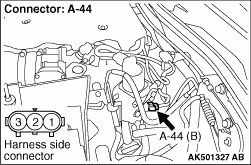

|
Q.
Are the check results normal?
Go to Step 5.
Repair or replace the connector.
|
|
| note |
Before checking harness, check intermediate connector A-131, and repair if necessary.
|
- Check power supply line for damage.
Q.
Is the check result normal?
Go to Step 6.
Repair the damaged harness wire.
|
|
| note |
Before checking harness, check intermediate connector A-131, and repair if necessary.
|
- Check output line for damage.
Q.
Is the check result normal?
Go to Step 7.
Repair the damaged harness wire.
|
|
| note |
Before checking harness, check intermediate connector A-131, and repair if necessary.
|
- Check earthing line for damage.
Q.
Is the check result normal?
Go to Step 8.
Repair the damaged harness wire.
|
|
|
- Remove the injector. Check whether there is the evidence of the fuel leakage from the injector body.
|
|
|
Q.
Is the check result normal?
|
|
|
Replace the abnormal injector. After replacing the injector, register the injector identification code and learn fuel injection. (Refer to GROUP 00 - Precautions Before Service - What The Common Rail Engine Learns ).
|
|
|
|
|
|
- After replacing the common rail assembly and fuel injection tubes, re-check the trouble symptoms.
|
|
|
Q.
Does the trouble symptom persist?
|
|
|
Replace the engine-ECU. When the engine-ECU is replaced, write the chassis number (Refer to GROUP 00 - Precautions Before Service - How to Perform Chassis Number Writing ). After replacing the engine-ECU, register the injector identification code and learn fuel injection (Refer to GROUP 00 - Precautions Before Service - What The Common Rail Engine Learns ). After registering the injector identification code, the vehicle equipped with the DPF carries out the forcible DPF regeneration. (Refer to GROUP 17 - Emission Control - Diesel Particulate Filter (DPF) System - Forcible DPF Regeneration ).
|
|
|
|