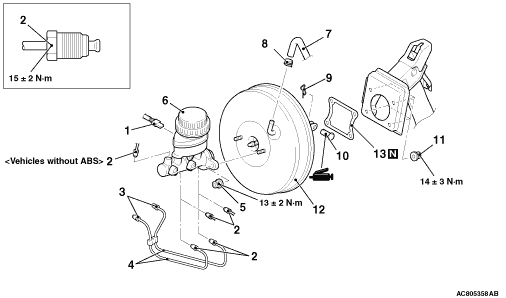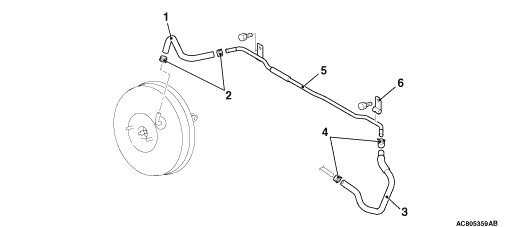

|
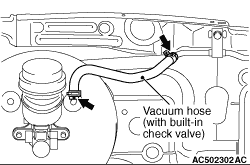
Install the vacuum hose and the clip so that the paint mark on the vacuum hose and the
clip are in the position shown in the figure.
|

|
1.Use the vacuum pump to measure dimension "A" applying a negative pressure of 66.7 kPa
to the brake booster.
Standard value (A):
10.0 - 10.1 mm <Vehicles without ASTC>
6.6 - 6.9 mm <Vehicles with ASTC>
| note |
When a negative pressure of 66.7 kPa is not applied to the brake booster, the push rod
protrusion amount (A) should be 9.0 - 9.1 mm <Vehicles without ASTC> , 7.7 - 7.9
mm <Vehicles with ASTC>.
|
|
|
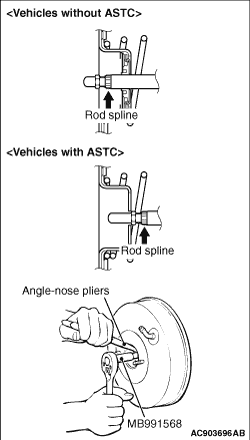
2.If the protrusion amount is not within the standard value range, adjust the push rod length
by turning the push rod. Use the special tool push rod adjusting socket (MB991568) to turn the
push rod while holding the rod spline with angle-nose pliers.
|
|
|
Brake fluid: DOT3 or DOT4
|
|
|
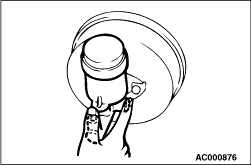
When removed the master cylinder assembly, bleed the master cylinder in the following
procedure to make bleeding of the brake pipeline easier (When no brake fluid is in the master cylinder).
|
|
|
1.Fill the brake fluid reservoir with the brake fluid.
|
|
|
2.Depress and hold the brake pedal.
|
|
3.Another operator closes the master cylinder outlets with his fingers.
4.In this condition, release the brake pedal.
5.Repeat Steps 2 to 4 for 3 or 4 times to fill the master cylinder with the brake fluid.
|