|
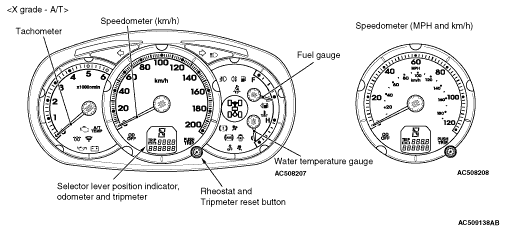
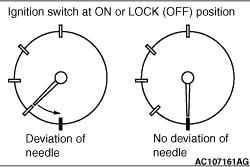
These gauges use a stepping motor as the drive mechanism for the indicators (called the "movement"). Compared with conventional movements, the torque for driving the indicators is much greater for superior indicator accuracy and more stable response. The indicator position displayed is determined as the microcontroller circuit in the gauge controls the stepping motor. In the case of a great impact such as from an accident when the indicator becomes misaligned, if the ignition is switched on to start driving while the indicator is misaligned, the indicator will function while misaligned. Thus, to return the indicator to the normal position in case this happens, when the ignition is switched on, the indicator positions are reset to their respective positions after the battery line is connected after it is cut. After the battery line is cut and reconnected, the indicators simply return to the zero position. The same operation is performed after voltage is restored if gauge functions are lost because of a voltage drop from cranking or the like. Furthermore, the indicator returns after the ignition is switched on or the lock is turned off. The indicator is not moved if it is not misaligned.
|
 .