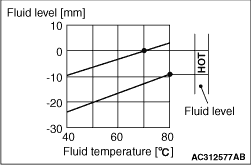
|
1.Drive the vehicle until the A/T fluid temperature reaches the normal temperature (70 -
80°C)
| note |
Measure A/T fluid temperature using M.U.T.-III.
|
| note |
Check the oil level referring to the characteristics chart shown at left if it takes some
time to reach the normal operation temperature of A/T fluid (70 -
80°C).
|
2.Park the vehicle on a level surface.
3.Move the selector lever to all positions to fully charge the torque converter and
the fluid lines with A/T fluid, and then move the selector lever to the N position.
4.Pull out the oil level gauge, and wipe off the A/T fluid and dirt. Then, insert the
oil level gauge again and pull it to check the condition of the A/T fluid.
| note |
If the A/T fluid has a burnt smell, or if it has become very contaminated or dirty, it
means that the A/T fluid has become contaminated by minute particles form bushings (metal) or
worn parts. In such a case, the transmission needs to be overhauled and the A/T fluid cooler
line needs to be flushed out.
|
|
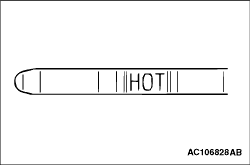
|
5.Check that the A/T fluid level is between the HOT marks on the oil level gauge. If the
A/T fluid level is too low, add more A/T fluid until the level reaches between the HOT marks.
Automatic transmission fluid: DIA QUEEN ATF SP III
| note |
If the A/T fluid level is too low, the oil pump draws air into the system along with the
A/T fluid, and air bubbles will thus from in the fluid circuit. This will cause a drop in fluid pressure
and cause the shift points to change and the clutches and brakes to slip. If the A/T fluid level
is too high, the gear will churn the A/T fluid and cause bubbles to develop, which can then
cause the same problems as when the A/T fluid is too low. In either case, the air bubbles can cause
overheating and oxidation of the A/T fluid, and also prevent the valves, clutches and brakes
from operating normally. In addition, if bubbles develop in the A/T fluid, the A/T fluid can
overflow from the transmission vent holes and be mistaken for leaks.
|
6.Securely re-insert the oil level gauge.
|