CONTROL OVERVIEW


SHIFT CONTROL


SOLENOID VALVE OPERATION


Gear
Solenoid valve
LR
2ND
UD
OD
DCC (Ref.)
1st
OFF
ON
OFF
ON
OFF
2nd
ON
OFF
OFF
ON
ON
3rd
ON
ON
OFF
OFF
ON
4th
ON
OFF
ON
OFF
ON
Reverse
OFF
ON
ON
ON
OFF
N, P
OFF
ON
ON
ON
OFF

SHIFT PATTERN CONTROL


INVECS-II controls the shift pattern to offer the optimum shift pattern depending on the road condition and driving operation.

INVECS-II


OPTIMUM SHIFT CONTROL


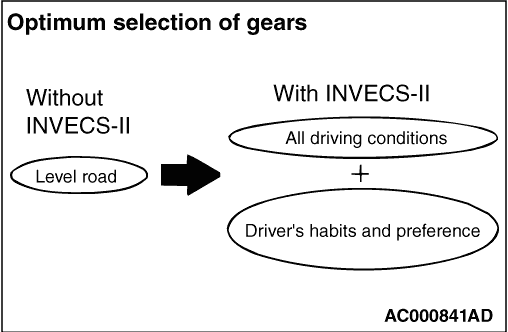
  1. The shift patterns found satisfying by the typical driver for all ranges of driving are stored in the computer’s memory. The computer uses this data to analyse road conditions and the driver’s style of operation, and then sends the optimal shift patterns stored in its memory to best match the conditions.
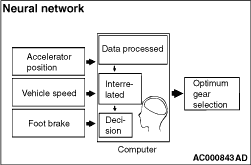
  2. We introduce the latest control technologies with an innovative new algorithm called the "neural network" that works to imitate the decision-making processes of the human brain. The neural network links a wide variety of input data regarding road and operating conditions, and instantly makes accurate shift control decisions.

ADAPTIVE SHIFT CONTROL


  1. The computer learns the driving habits and preferences of each individual driver by processing driving data on engine output, tyre load, foot brake operation, etc. It then uses this data to adjust shift timing to best suit the driver’s style.
  2. If the computer determines from the driving patterns that the driver is one who enjoys a relaxed, unhurried style, it adjusts timing to execute up-shifts at a lower engine speed to provide a smooth, quiet ride. On the other hand, if the computer determines the driver to prefer a sporty ride, it adjusts timing to shift up at a higher engine speed to provide more powerful response.


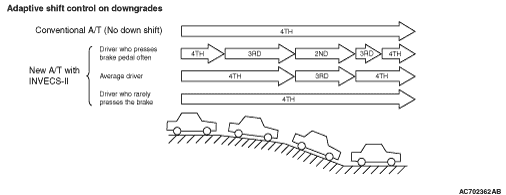
  3. If the computer determines that the driver tends to apply the brakes often on a descending roadway, it adjusts timing to down shift sooner so that engine braking is more effectively applied. Conversely, if the computer determines that the driver does not brake much while driving downhill, it delays downshifting to minimize the effect of engine braking.