Code No. P0300: Random/Multiple Cylinder Misfire Detected


OPERATION


  • Refer to Code No. P0201: No. 1 Injector System .
  • Refer to Code No. P0202: No. 2 Injector System .
  • Refer to Code No. P0203: No. 3 Injector System .
  • Refer to Code No. P0204: No. 4 Injector System .

FUNCTION


  • If a misfire occurs while the engine is running, the engine speed changes for an instant.
  • The engine-ECU checks for such changes in engine speed.

TROUBLE JUDGMENT


Check Conditions
  • Engine speed is more than 440 r/min and is less than 6,500 r/min.
  • Engine coolant temperature is more than -10°C.
  • Barometric pressure is more than 76 kPa.
  • Volumetric efficiency is more than 30 % and is less than 60 %.
  • Adaptive learning is complete for the vane which generates a crankshaft position signal.
  • While the engine is running, excluding gear shifting, deceleration, sudden acceleration/deceleration and A/C compressor switching.
  • The throttle deviation is -0.06 V/10 ms to +0.06 V/10 ms.
Judgement Criterion (change in the angular acceleration of the crankshaft is used for misfire detection).
  • Misfire has occurred more frequently than allowed during the last 200 revolutions (when the catalyst temperature is more than 1,000°C).


  • Misfire has occurred in 15 or more of the last 1,000 revolutions (corresponding to 1.5 times the limit of emission standard).

PROBABLE CAUSES


  • Ignition system related part(s) failed
  • Failed crank angle sensor
  • Failed injector
  • Incorrect air-fuel ratio
  • Low compression pressure
  • Failed intake air temperature sensor
  • Failed engine coolant temperature sensor
  • Failed air flow sensor
  • Skipping of timing chain teeth.
  • Exhaust gas recirculation system and exhaust gas recirculation valve failed
  • Failed engine-ECU

DIAGNOSIS PROCEDURE


STEP 1.M.U.T.-III data list


  • Refer to Data List Reference Table .

  1. Item 2: Crank angle sensor

Q. Is the check result normal?

Go to Step 2 .
Check crank angle sensor system (Refer to Code No. P0335 ).

STEP 2. M.U.T.-III data list


  • Refer to Data List Reference Table .

  1. Item 5: Intake air temperature sensor
  2. Item 6: Engine coolant temperature sensor
  3. Item 10: Air flow sensor
  4. Item 26: Long-term fuel compensation
  5. Item 28: Short-term fuel compensation

Q. Are the check results normal?

Go to Step 3 .
Perform the diagnosis code classified check procedure for the sensor that has shown an abnormal data value (Refer to Inspection Chart for Diagnosis Code ).

STEP 3. Visual check of ignition spark.


  • Remove the spark plug and install it to the ignition coil.
  • Connect the ignition coil connector.
  • Disconnect all injector connectors.
  • At the engine start, check each spark plug produces a spark.

Q. Is the check result normal?

Go to Step 4 .
Check ignition circuit system (Refer to Inspection Procedure 22 ).

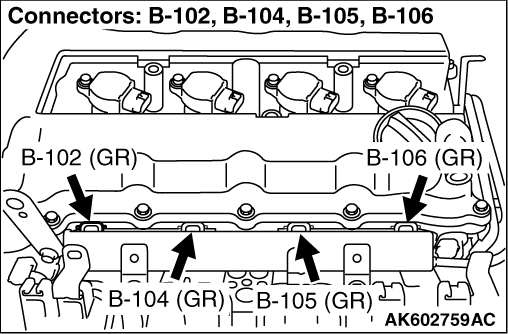
STEP 4. Connector check: Injector connector


  1. B-102 (No. 1 injector connector)
  2. B-104 (No. 2 injector connector)
  3. B-105 (No. 3 injector connector)
  4. B-106 (No. 4 injector connector)

Q. Are the check results normal?

Go to Step 5 .
Repair or replace the connector.

STEP 5. Check injector itself.


  • Check injector itself (Refer to Injector Check ).

Q. Is the check result normal?

Go to Step 6 .
Replace the injector.

STEP 6. Check for intake of air from intake hose and inlet manifold.


Q. Is the check result normal?

Go to Step 7 .
Repair.

STEP 7. Fuel pressure measurement.


  • Fuel pressure measurement (Refer to Fuel Pressure Test )

Q. Is the check result normal?

Go to Step 8 .
Repair.

STEP 8. Check for skipped timing chain teeth.


Q. Is the check result normal?

Go to Step 9 .
Replace the timing chain.

STEP 9. Check exhaust gas recirculation valve (stepper motor) itself.


  • Check exhaust gas recirculation valve (stepper motor) itself (Refer to GROUP 17 - Emission Control <MPI> - Exhaust Gas Recirculation (EGR) Valve - Exhaust Gas Recirculation Valve (Stepper Motor) Check ).

Q. Is the check result normal?

Go to Step 10.
Replace the exhaust gas recirculation valve (stepper motor)

STEP 10. Check compression pressure.


  • Check the compression pressure (Refer to GROUP 11E - On-vehicle Service - Compression Pressure Check ).

Q. Is the check result normal?

Go to Step 11 .
Repair.

STEP 11. Replace the engine-ECU.


  • After replacing the engine-ECU, re-check the trouble symptom.

Q. Is the check result normal?

Check end.
Check for foreign matters (water, kerosene, etc.) in fuel and replace if necessary.