|
|
The output signals of the sensors and the conditions of the actuation signals of the actuators can be inspected visually by observing the waveforms on the oscilloscope.
|
|
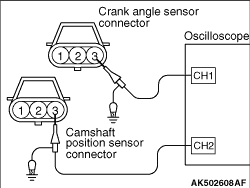
1.Disconnect the camshaft position sensor connector and insert the special tool test harness (MB991709) in-between the separated connectors (Always mate all the terminals).
2.Disconnect the crank angle sensor connector and insert the special tool test harness (MB991709) in-between the separated connectors (Always mate all the terminals).
3.Connect the probe of each channel of the oscilloscope to terminal No. 3 of the camshaft position sensor connector and terminal No. 3 of the crank angle sensor connector, respectively.
|
|
|
1.Disconnect the engine-ECU connector and connect the special tool Power plant ECU check harness (MB992110) in between.
|
|
|
2.Connect the oscilloscope special patterns pickup to engine-ECU connector terminal CPI (when checking the camshaft position sensor signal wave pattern).
|
|
|
3.Connect the oscilloscope special patterns pickup to engine-ECU connector terminal SGT (when checking the crank angle sensor signal wave pattern).
|
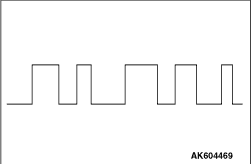
|
Wave pattern characteristics
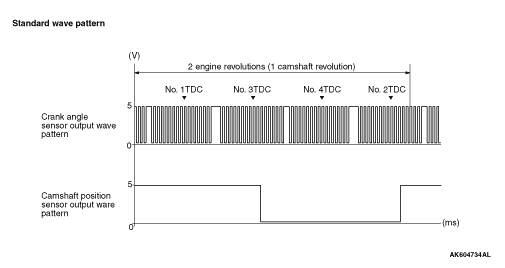
Rectangular wave will be output while the engine is not started.
|
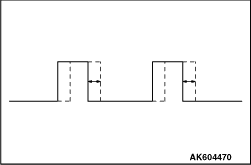
|
Wave pattern characteristics
Wave pattern is displaced in the forward or backward direction.
Cause of problem
Loose timing chain
Abnormal sensing section
|
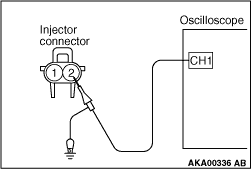
|
1.Disconnect the injector connector and insert the special tool Test harness (MB991658) in-between the separated connectors. (always mate all the terminals.)
2.Connect the oscilloscope probe to terminal No. 2 of the injector connector.
|
|
|
1.Disconnect the engine-ECU connector and connect the special tool Power plant ECU check harness (MB992110) in between.
|
|
|
2.Connect the oscilloscope special patterns pickup to engine-ECU connector terminal INJ1 (when checking the No. 1 cylinder).
|
|
|
3.Connect the oscilloscope special patterns pickup to engine-ECU connector terminal INJ2 (when checking the No. 2 cylinder).
|
|
|
4.Connect the oscilloscope special patterns pickup to engine-ECU connector terminal INJ3 when checking the No. 3 cylinder).
|
|
|
5.Connect the oscilloscope special patterns pickup to engine-ECU connector terminal INJ4 (when checking the No. 4 cylinder).
|
|
|
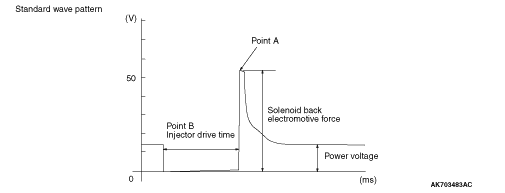
- Point A: The level of counter electromotive force of solenoid coil:
|
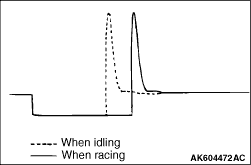
|
- Point B: Injector operation time
Operation time
|
Consistent with the displayed time on M.U.T.-III.
|
Force an excessive acceleration.
|
The drive period will once extend greatly, then will be settled to that corresponding to the engine speed.
|
|
|
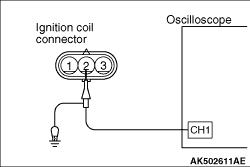
1.Disconnect the ignition coil connector and insert the special tool test harness (MB991658) in-between the separated connectors. (Always mate all the terminals.)
2.Connect the oscilloscope probe to terminal No. 2 of the ignition coil connector.
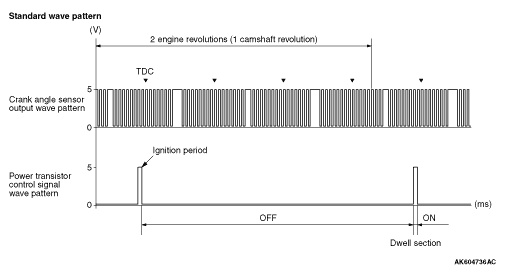
3.To verify the ignition advance angle, observe it simultaneously with the crank angle sensor output signals.
|
|
|
1.Disconnect the engine-ECU connector and connect the special tool Power plant ECU check harness (MB992110) in between.
|
|
|
2.Connect the oscilloscope probe to engine-ECU connector terminal CIL1. (when checking the No. 1 cylinder.)
|
|
|
3.Connect the oscilloscope probe to engine-ECU connector terminal CIL2. (when checking the No. 2 cylinder.)
|
|
|
4.Connect the oscilloscope probe to engine-ECU connector terminal CIL3. (when checking the No. 3 cylinder.)
|
|
|
5.Connect the oscilloscope probe to engine-ECU connector terminal CIL4. (when checking the No. 4 cylinder.)
|
|
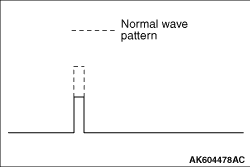
Wave pattern characteristics
Cause of problem
Open-circuit in the ignition primary circuit.
|