|
|
Use M.U.T.-III to diagnose the CAN bus lines.
|
|
|
Q.
Is the check result normal?
|
|
|
 Repair the CAN bus line (Refer to GROUP 54C - Troubleshooting Repair the CAN bus line (Refer to GROUP 54C - Troubleshooting  ). ).
|
|
|
|
|
|
(1)Connect the negative battery terminal.
|
|
|
(2)After erasing the diagnosis code memory, check the diagnosis code again.
|
|
|
(3)Disconnect the negative battery terminal.
|
|
|
Q.
Is the diagnosis code No. B1401 set?
|
|
|
Intermittent malfunction (Refer to GROUP 00 - How to Use Troubleshooting/Inspection
Service Points - How to Cope with Intermittent Malfunction ).
|
|
|
|
|
|
(1)Check that the negative battery terminal is disconnected. If the negative battery
terminal is connected, disconnect it.
|
|
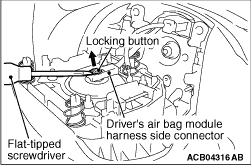
(2)Use the flat-tipped screwdriver to pull out the locking button of wiring harness side
connector, and release the lock.
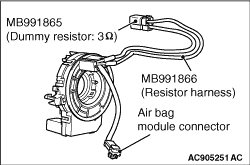
(3)Connect special tool dummy resistor (MB991865) to special tool resistor harness
(MB991866).
|
|
(4)| caution |
Do not insert a probe directly into the terminal from the connector
front side as the connector contact pressure may be weakened.
|
Insert the resistor harness probe (special tool) as shown.
(5)Connect the negative battery terminal.
(6)After erasing the diagnosis code memory, check the diagnosis code again.
(7)Disconnect the negative battery terminal.
Q.
Is the diagnosis code No. B1401 set?
 Go to Step 4 Go to Step 4
Replace the driver’s air bag module (Refer to ).
|
|
|
(1)Check that the negative battery terminal is disconnected. If the negative battery
terminal is connected, disconnect it.
|
|
|
(2)Disconnect the clock spring connector.
|

|
(3)Connect special tool dummy resistor (MB991865) to special tool resistor harness (MB991866).
(4)| caution |
Do not insert a probe directly into the terminal from the connector
front side as the connector contact pressure may be weakened.
|
Insert the resistor harness probe from the back of harness side connector DQ1-, DQ1+ line.
(5)Connect the negative battery terminal.
(6)After erasing the diagnosis code memory, check the diagnosis code again.
(7)Disconnect the negative battery terminal.
Q.
Is the diagnosis code No. B1401 set?
Go to Step 5
Replace the clock spring (Refer to ).
|
|
|
(1)Check that the negative battery terminal is disconnected. If the negative battery
terminal is connected, disconnect it.
|
|
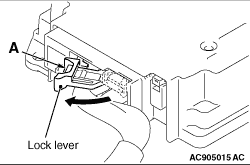
(2)While pushing the part "A" indicated in the figure of the harness side connector, turn
the lock lever to the direction of the arrow to release the lock lever, and disconnect the SRS-ECU
connector.
(3)| caution |
To release SRS-ECU connector short spring in the following
operations, disconnect this clock spring connector, and keep the squib circuit shorted.
|
Disconnect the clock spring connector.
|

|
(4)| caution |
The short spring may not be released due to the insufficient insertion. Therefore, insert
the insulator for 4 mm or more.
|
Insert the insulator (width: 3 mm, thickness: 0.5 mm) such as cable tie between the DQ1-,
DQ1+ line, and then release the short spring.
(5)| caution |
Do not insert a probe directly into the terminal of clock spring harness
side connector from the connector front side as the connector contact pressure may be weakened.
|
Take the measurements below at the SRS-ECU connector and clock spring connector harness
side connectors.
- Continuity DQ1- line between SRS-ECU connector and clock
spring connector
- Continuity DQ1+ line between SRS-ECU connector and clock spring connector
OK: Continuity (less than 2 Ω)
Q.
Is the check result normal?
Go to Step 6
Repair the wiring harnesses between DQ1-, DQ1+ line the clock spring
connector and the SRS-ECU connector.
|
|
|
Q.
Is the diagnosis code No. B1401 set?
|
|
|
Replace SRS-ECU (Refer to ).
|
|
|
|
|
|
Intermittent malfunction (Refer to GROUP 00 - How to Use Troubleshooting/Inspection
Service Points - How to Cope with Intermittent Malfunction ).
|
|
|
|