COMPRESSION PRESSURE CHECK
| 1.Before inspection, check that the engine oil, starter and battery are normal. In addition,
set the vehicle to the pre-inspection condition. |
| 2.Turn the ignition switch to "LOCK" (OFF) position. |
| 3.Remove the EGR pipe. |
| 4.Remove all of the glow plugs. |
 |
5.Disconnect the injector connector of all cylinders.
|
 |
7.Set compression gauge to one of the glow plug holes. 8.Crank the engine and measure the compression pressure. Standard value (at engine speed of 150 r/min): 2,400 kPa Limit (at engine speed of 150 r/min): min. 2,100 kPa 9.Measure the compression pressure for all the cylinders, and check that the pressure differences of the cylinders are below the limit. Limit: max 300 kPa 10.If there is a cylinder with compression or a compression difference that is outside the limit, pour a small amount of engine oil through the glow plug hole, and repeat the operations in steps 7 and 8. (1) If the compression increases after oil is added, the cause of the malfunction is a worn or damaged piston ring and/or cylinder inner surface. (2) If the compression does not rise after oil is added, the cause is a burnt or defective valve seat, or pressure is leaking from the gasket. 11.Turn the ignition switch to "LOCK" (OFF) position. 12.Connect the injector connector of all cylinders. 13.Install the glow plugs. Tightening torque: 17 ± 2 N·m 14.Install the EGR pipe. |
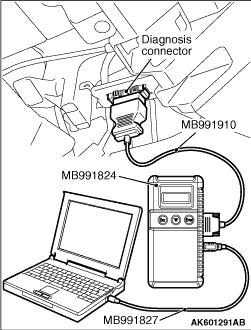 |
15.Use the M.U.T.-III to erase the diagnosis codes.
|