Code No. P2122: Accelerator Pedal Position Sensor (Main) Circuit Low Input


OPERATION
- A power voltage of 5 V is applied to the accelerator
pedal position sensor (terminal No. 1) from the engine-A/T-ECU (terminal No. 92).
- The power voltage is earthed to the engine-A/T-ECU (terminal No. 91) from the accelerator
pedal position sensor (terminal No. 2).
- The sensor signal is inputted to the engine-A/T-ECU (terminal No. 114) from the accelerator
pedal position sensor output terminal (terminal No. 3).
FUNCTION
- The accelerator pedal position sensor (main) outputs
voltage which corresponds to the accelerator pedal depression.
- The engine-A/T-ECU checks whether the voltage is within a specified range.
TROUBLE JUDGMENT
Check Condition
- Ignition switch is in "ON" position.
- Accelerator pedal position sensor (main) output voltage is less than 0.6 V.
PROBABLE CAUSES
- Failed accelerator pedal position sensor
- Open/short circuit or harness damage in accelerator pedal position sensor circuit
or loose connector contact
- Failed engine-A/T-ECU
DIAGNOSIS PROCEDURE |
STEP 1. M.U.T.-III data list |
|
Q.
Is the check result normal?
|
 Intermittent malfunction (Refer to GROUP 00 -
How to Use Troubleshooting/Inspection
Service Points -
How to Cope with Intermittent Malfunctions Intermittent malfunction (Refer to GROUP 00 -
How to Use Troubleshooting/Inspection
Service Points -
How to Cope with Intermittent Malfunctions  ). ). |
|
 Go to Step 2 . Go to Step 2 . |
|
STEP 2. Connector check: D-202 accelerator pedal position sensor connector |
Q.
Is the check result normal?
|
| Go to Step 3 . |
|
| Repair or replace the connector. |
|
STEP 3. Perform voltage measurement at D-202 accelerator pedal position sensor connector. |
|
| OK: 4.9 -
5.1 V |
Q.
Is the check result normal?
|
| Go to Step 7 . |
|
| Go to Step 4 . |
|
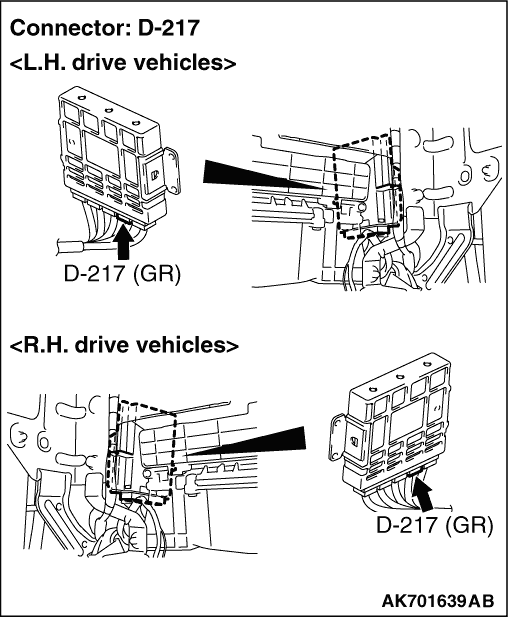
STEP 4. Connector check: D-202 engine-A/T-ECU connector |
Q.
Is the check result normal?
|
| Go to Step 5 . |
|
| Repair or replace the connector. |
|
STEP 5. Check harness between D-202 (terminal No. 1) accelerator pedal position sensor connector and D-217 (terminal No. 92) engine-A/T-ECU connector. |
|
Q.
Is the check result normal?
|
| Go to Step 6 . |
|
| Repair the damaged harness wire. |
|
STEP 6. M.U.T.-III data list |
|
Q.
Is the check result normal?
|
| Intermittent malfunction (Refer to GROUP 00 -
How to Use Troubleshooting/Inspection
Service Points -
How to Cope with Intermittent Malfunctions ). |
|
| Replace the engine-A/T-ECU. |
|
STEP 7. Connector check: D-217 engine-A/T-ECU connector |
Q.
Is the check result normal?
|
| Go to Step 8 . |
|
| Repair or replace the connector. |
|
STEP 8. Check harness between D-202 (terminal No. 1) accelerator pedal position sensor connector and D-217 (terminal No. 92) engine-A/T-ECU connector. |
|
Q.
Is the check result normal?
|
| Go to Step 9 . |
|
| Repair the damaged harness wire. |
|
STEP 9. Check harness between D-202 (terminal No. 3) accelerator pedal position sensor connector and D-217 (terminal No. 114) engine-A/T-ECU connector. |
|
Q.
Is the check result normal?
|
| Go to Step 10 . |
|
| Repair the damaged harness wire. |
|
STEP 10. Replace the accelerator pedal assembly. |
|
Q.
Is the check result normal?
|
| Check end. |
|
| Replace the engine-A/T-ECU. |
|