|
|
- The gear changing mechanism utilizes four multi-disc clutches and two one-way
clutches.
|

|
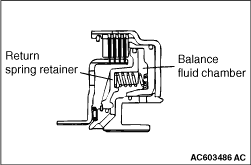
The underdrive clutch operates in 1st, 2nd, 3rd and 4th gears and transmits driving force
from the input shaft to the underdrive sun gear. The components comprising the underdrive clutch
are as illustrated on the left. Hydraulic pressure acts in the piston pressure chamber (between
the piston and retainer) and thus pushes the piston. In turn, the piston depresses the clutch
discs and thereby transmits driving force from the retainer to the hub side.
|
|
At high speeds, fluid remaining in the piston pressure chamber is subjected to centrifugal
force and attempts to push the piston. However, fluid in the balance fluid chamber (the space between
the piston and return spring retainer) is also subjected to centrifugal force. Thus, the hydraulic
pressure on one side of the piston cancels out the hydraulic pressure on the other side, and
the piston does not move.
|
|
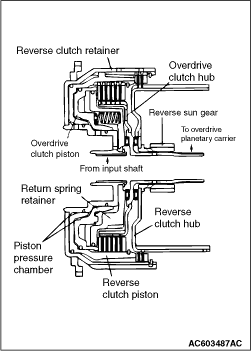
The reverse clutch operates when reverse gear is selected and transmits driving force
from the input shaft to the reverse sun gear. The overdrive clutch operates in 3rd, 4th and
5th gears and transmits driving force from the input shaft to the overdrive planetary carrier
and low-reverse annulus gear.
|
|
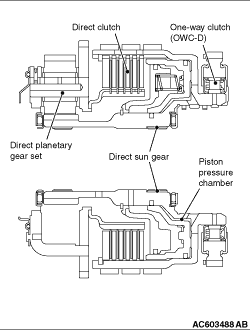
The direct clutch is applied in the 4th and 5th speeds, and connects the direct planetary
gears and direct sun gears. The direct clutch consists of the parts shown in the illustration.
The hydraulic pressure is applied between the piston and retainer to transmit the drive force
from the retainer to the hub when the piston presses against the clutch disc.
|
|
|
A sprag type one-way clutch is incorporated. This is applied in the 1st, 2nd and 3rd gears
and limits the rotation direction to one direction. When the speed varies, the direct pinion
turns in anti-clockwise, so this clutch stops the direct sun gears from turning in clockwise.
|