Code No. P0500: Vehicle Speed Sensor System


OPERATION


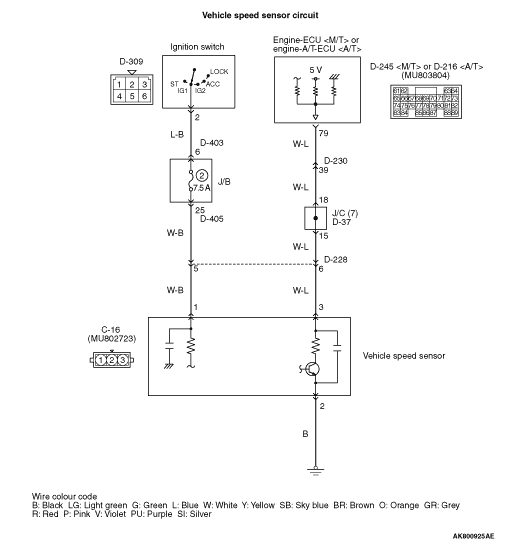
  • Power is supplied to the vehicle speed sensor (terminal No. 1) from the ignition switch (terminal No. 2) and is earthed to the vehicle body from the vehicle speed sensor (terminal No. 2).
  • A power voltage of 5 V is applied to the vehicle speed sensor (terminal No. 3) from the engine-ECU <M/T> or engine-A/T-ECU <A/T> (terminal No. 79).

FUNCTION


  • The vehicle speed sensor converts the vehicle speed to the voltage, and then input it into the engine-ECU <M/T> or engine-A/T-ECU <A/T>.

TROUBLE JUDGMENT <M/T>


Check Conditions
  • 2 seconds later after the engine has started up.
  • Engine speed is 2,500 - 4,000 r/min.
  • The volumetric efficiency is about 50 to 70 %.
Judgment Criterion
  • The sensor output voltage remains unchanged (no pulse signal is inputted) for 4 seconds.

TROUBLE JUDGMENT <A/T>


Check Conditions
  • Not in the mode at extremely low temperatures.
  • Transmission: Except P range, N range and R range.
  • The output shaft speed is 900 r/min or higher.
Judgment Criterion
  • The sensor output voltage does not change for 30 seconds (no pulse signal input).

PROBABLE CAUSES


  • Failed vehicle speed sensor
  • Open/short circuit or harness damage in vehicle speed sensor circuit or loose connector contact
  • Failed engine-ECU <M/T> or engine-A/T-ECU <A/T>

DIAGNOSIS PROCEDURE


STEP 1. M.U.T.-III data list


  • Refer to Data List Reference Table .

  1. Item 04: Vehicle speed sensor

Q. Is the check result normal?

Intermittent malfunction (Refer to GROUP 00 - How to Use Troubleshooting/Inspection Service Points - How to Cope with Intermittent Malfunctions ).
Go to Step 2 .

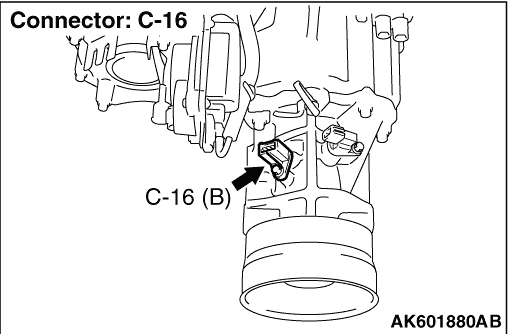
STEP 2. Connector check: C-16 vehicle speed sensor connector


Q. Is the check result normal?

Go to Step 3 .
Repair or replace the connector.

STEP 3. Check vehicle speed sensor itself.


  • Check vehicle speed sensor itself (Refer to GROUP 54A - Combination Meter - Combination Meter Assembly - Vehicle Speed Sensor Check ).

Q. Is the check result normal?

Go to Step 4 .
Replace the vehicle speed sensor.

STEP 4. Perform voltage measurement at C-16 vehicle speed sensor connector.


  • Disconnect connector, and measure at harness side.
  • Ignition switch: ON
  • Voltage between terminal No. 3 and earth.
OK: 4.9 - 5.1 V

Q. Is the check result normal?

Go to Step 8 .
Go to Step 5 .

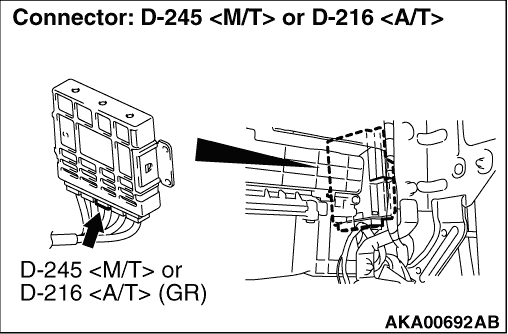
STEP 5. Connector check: D-245 engine-ECU <M/T> connector or D-216 engine-A/T-ECU <A/T> connector.


Q. Is the check result normal?

Go to Step 6 .
Repair or replace the connector.

STEP 6. Check harness between C-16 (terminal No. 3) vehicle speed sensor connector and D-245 (terminal No. 79) engine-ECU <M/T> connector or D-216 (terminal No. 79) engine-A/T-ECU <A/T> connector.


note Before checking harness, check intermediate connectors D-37, D-228 and D-230, and repair if necessary.

  • Check output line for open/short circuit.

Q. Is the check result normal?

Go to Step 7 .
Repair the damaged harness wire.

STEP 7. M.U.T.-III data list


  • Refer to Data List Reference Table .

  1. Item 04: Vehicle speed sensor

Q. Is the check result normal?

Intermittent malfunction (Refer to GROUP 00 - How to Use Troubleshooting/Inspection Service Points - How to Cope with Intermittent Malfunctions ).
Replace the engine-ECU <M/T> or engine-A/T-ECU <A/T>.

STEP 8. Perform voltage measurement at C-16 vehicle speed sensor connector.


  • Disconnect connector, and measure at harness side.
  • Ignition switch: ON
  • Voltage between terminal No. 1 and earth.
OK: System voltage

Q. Is the check result normal?

Go to Step 10 .
Go to Step 9 .

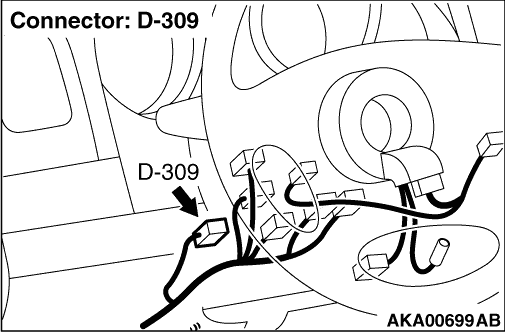
STEP 9. Connector check: D-309 ignition switch connector


Q. Is the check result normal?


    Check intermediate connectors D-228, D-403 and D-405, and repair if necessary. If intermediate connectors are normal, check and repair harness between D-309 (terminal No. 2) ignition switch connector and C-16 (terminal No. 1) vehicle speed sensor connector.

    • Check power supply line for open/short circuit.
Repair or replace the connector.

STEP 10. Perform resistance measurement at C-16 vehicle speed sensor connector.


  • Disconnect connector, and measure at harness side.
  • Resistance between terminal No. 2 and earth.
Continuity (2 Ω or less)

Q. Is the check result normal?

Go to Step 11 .

    Check and repair harness between C-16 (terminal No. 2) vehicle speed sensor connector and body earth.

    • Check earthing line for open circuit and damage.

STEP 11. Connector check: D-245 engine-ECU <M/T> connector or D-216 engine-A/T-ECU <A/T> connector


Q. Is the check result normal?

Go to Step 12 .
Repair or replace the connector.

STEP 12. Check harness between C-16 (terminal No. 3) vehicle speed sensor connector and D-245 (terminal No. 79) engine-ECU <M/T> connector or D-216 (terminal No. 79) engine-A/T-ECU <A/T> connector.


note Before checking harness, check intermediate connectors D-37, D-228 and D-230, and repair if necessary.

  • Check output line for damage.

Q. Is the check result normal?

Go to Step 13 .
Repair the damaged harness wire.

STEP 13. Connector check: D-309 ignition switch connector


Q. Is the check result normal?

Go to Step 14 .
Repair or replace the connector.

STEP 14. Check harness between C-16 (terminal No. 1) vehicle speed sensor connector and D-309 (terminal No. 2) ignition switch connector.


note Before checking harness, check intermediate connectors D-228, D-403 and D-405, and repair if necessary.

  • Check power supply line for damage.

Q. Is the check result normal?

Go to Step 7 .
Repair the damaged harness wire.