Code No. P0304: No. 4 Cylinder Misfire Detected


OPERATION
- Refer to Code No. P0204: No. 4 Injector System
 .
.
FUNCTION
- If a misfire occurs while the engine is running, the engine
speed changes for an instant.
- The engine-ECU <M/T> or engine-A/T-ECU <A/T> checks for such changes in
engine speed.
TROUBLE JUDGMENT
Check Conditions
- Engine speed is 440 - 4,500 r/min.
- Engine coolant temperature and intake air temperature are -10°C
or higher.
- Barometric pressure is 106 kPa or lower.
- Volumetric efficiency is between 15 % and 100 %.
- Adaptive learning is complete for the vane which generates a crankshaft position
signal.
- While the engine is running, excluding gear shifting, deceleration, sudden acceleration/deceleration
and A/C compressor switching.
- The throttle deviation is -0.06 V/10 ms to +0.06 V/10 ms.
- Misfire has occurred more frequently than the limit during the last 200 revolutions
(when the catalyst temperature has been 950°C or higher).
or - The misfire ratio goes beyond the permitted limit within the last 1,000 revolutions
from when the exhaust gas exceeds the regulation value.
PROBABLE CAUSES
- Ignition system related part(s) failed
- Low compression pressure
- Failed engine-ECU <M/T> or engine-A/T-ECU <A/T>
DIAGNOSIS PROCEDURE |
STEP 1. Visual check of ignition spark. |
|
Q.
Is the check result normal?
|
 Go to Step 3 . Go to Step 3 . |
|
 Go to Step 2 . Go to Step 2 . |
|
STEP 2. Check spark plug. |
|
Q.
Is the check result normal?
|
| Check ignition circuit system (Refer to Inspection Procedure 26 ). |
|
| Replace spark plug. |
|
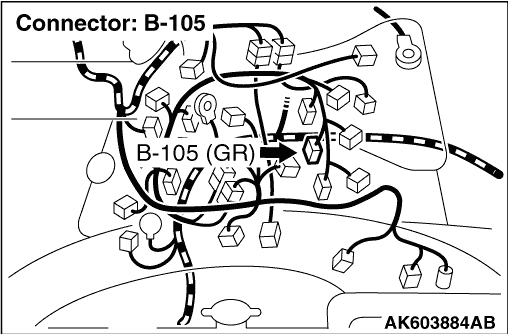
STEP 3. Connector check: B-105 No. 4 injector connector |
Q.
Is the check result normal?
|
| Go to Step 4 . |
|
| Repair or replace the connector. |
|
STEP 4. Check No. 4 injector itself. |
|
Q.
Is the check result normal?
|
| Go to Step 5 . |
|
| Replace the No. 4 injector. |
|
STEP 5. Connector check: B-15X engine control relay connector and D-243 engine-ECU <M/T> connector or D-212 engine-A/T-ECU <A/T> connector |
Q.
Is the check result normal?
|
| Go to Step 6 . |
|
| Repair or replace the connector. |
|
STEP 6. Check harness between B-15X (terminal No. 1) engine control relay connector and B-105 (terminal No. 1) No. 4 injector connector. |
|
|
Q.
Is the check result normal?
|
| Go to Step 7 . |
|
| Repair the damaged harness wire. |
|
STEP 7. Check harness between B-105 (terminal No. 2) No. 4 injector connector and D-243 (terminal No. 21) engine-ECU <M/T> connector or D-212 (terminal No. 21) engine-A/T-ECU <A/T> connector |
|
|
Q.
Is the check result normal?
|
| Go to Step 8 . |
|
| Repair the damaged harness wire. |
|
STEP 8. Fuel pressure measurement. |
|
Q.
Is the check result normal?
|
| Go to Step 9 . |
|
| Repair. |
|
STEP 9. Check compression pressure. |
|
Q.
Is the check result normal?
|
| Go to Step 10 . |
|
| Repair the compression pressure. |
|
STEP 10. Check the trouble symptoms. |
Q.
Does trouble symptom persist?
|
| Replace the engine-ECU <M/T> or engine-A/T-ECU <A/T>. |
|
| Intermittent malfunction (Refer to GROUP 00 - How to Use Troubleshooting/Inspection
Service Points - How to Cope with Intermittent Malfunctions ). |
|