|
|
Item 5: Input shaft speed sensor (Refer to data list reference table  ). ).
|
|
|
Q.
Is the check result normal?
|
|
|
 Intermittent malfunction (Refer to GROUP 00 - How to Cope with Intermittent Malfunction ). Intermittent malfunction (Refer to GROUP 00 - How to Cope with Intermittent Malfunction ).
|
|
|
|
|
|
Check for the contact with terminals.
|
|
|
Q.
Is the check result normal?
|
|
|
 Repair the defective connector. Repair the defective connector.
|
|
|
|
|
|
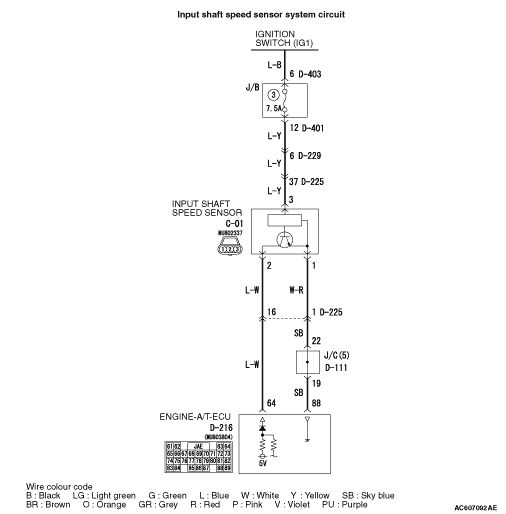
Disconnect the connector, and measure the resistance between terminal 1 and earth at the wiring harness side.
|
|
|
OK: Continuity (Less than 2 Ω)
|
|
|
Q.
Is the check result normal?
|
|
|
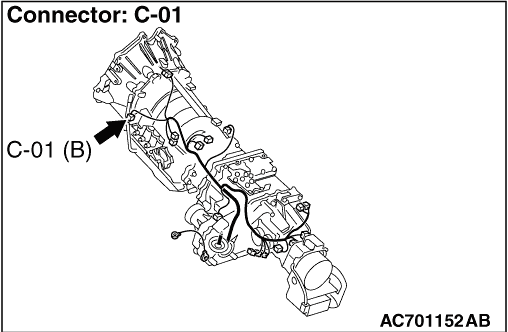
(1)Connect input shaft speed sensor connector C-01.
|
|
|
(2)Turn the ignition switch to the ON position.
|
|
|
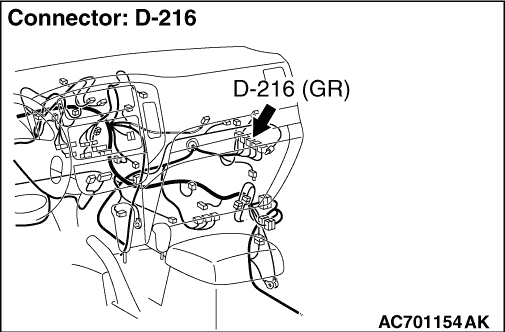
(3)Measure the voltage between engine-A/T-ECU connector D-216 terminal No.88 and earth.
OK: 0.5 V or less
|
|
|
Q.
Is the check result normal?
|
|
|
Check for the contact with terminals.
|
|
|
Q.
Is the check result normal?
|
|
|
Repair the defective connector.
|
|
|
|
|
|
Item 5: Input shaft speed sensor (Refer to data list reference table ).
|
|
|
Q.
Is the check result normal?
|
|
|
Intermittent malfunction (Refer to GROUP 00 - How to Cope with Intermittent Malfunction ).
|
|
|
|
|
|
Replace the engine-A/T-ECU.
|
|
|
|
|
|
Check for the contact with terminals.
|
|
|
Q.
Is the check result normal?
|
|
|
Repair the defective connector.
|
|
|
|
|
|
Check the earth line for open circuit.
|
|
|
Q.
Is the check result normal?
|
|
|
Repair the wiring harness.
|
|
|
|
|
|
(1)Disconnect the connector, and measure the voltage between terminal 3 and earth at the wiring harness side.
|
|
|
(2)Turn the ignition switch to the ON position.
OK: System voltage
|
|
|
Q.
Is the check result normal?
|
|
|
Check for the contact with terminals.
|
|
|
Q.
Is the check result normal?
|
|
|
Repair the defective connector.
|
|
|
|
|
|
Check the power supply line for short and open circuit.
|
|
|
Q.
Is the check result normal?
|
|
|
Repair the wiring harness.
|
|
|
|
|
|
(1)Disconnect the connector, and measure the voltage between terminal 2 and earth at the wiring harness side.
|
|
|
(2)Turn the ignition switch to the ON position.
OK: 4.5 - 4.9 V
|
|
|
Q.
Is the check result normal?
|
|
|
(1)Disconnect input shaft speed sensor connector C-01.
|
|
|
(2)Turn the ignition switch to the ON position.
|
|
|
(3)Measure the voltage between engine-A/T-ECU connector D-216 terminal No.64 and earth.
OK: 4.5 - 4.9 V
|
|
|
Q.
Is the check result normal?
|
|
|
Check for the contact with terminals.
|
|
|
Q.
Is the check result normal?
|
|
|
Repair the defective connector.
|
|
|
|
|
|
Check the output line for short circuit.
|
|
|
Q.
Is the check result normal?
|
|
|
Repair the wiring harness.
|
|
|
|
|
|
Check for the contact with terminals.
|
|
|
Q.
Is the check result normal?
|
|
|
Repair the defective connector.
|
|
|
|
|
|
Check the output line for open circuit.
|
|
|
Q.
Is the check result normal?
|
|
|
Repair the wiring harness.
|
|
|
|
|
|
(1)Shift the selector lever to the D range.
|
|
|
(2)Accelerate the vehicle to approximately 50 km/h (shift range; 3rd).
|
|
|
(3)Connect an oscilloscope, and measure the voltage between engine-A/T-ECU connector D-216 terminal No.64 and earth.
OK: A wave pattern such as the one shown on (Check Procedure Using an Oscilloscope) should be output, and the maximum value should be 4.8 V or more and the minimum value should be 0.8 V or less. There should be no noise in the output wave pattern.
|
|
|
Q.
Is the check result normal?
|
|
|
Check for the contact with terminals.
|
|
|
Q.
Is the check result normal?
|
|
|
Repair the defective connector.
|
|
|
|
|
|
(1)Replace the input shaft speed sensor.
|
|
|
(2)Test drive the vehicle.
|
|
|
(3)Check if the diagnosis code is set.
|
|
|
Q.
Is diagnosis code P1766 (P0715) set?
|
|
|
The inspection is complete.
|
|
|
|
|
|
Visually check the reverse clutch retainer for damage.
|
|
|
Q.
Is the check result normal?
|
|
|
Eliminate the cause of the noise.
|
|
|
|
|
|
Replace the reverse clutch retainer.
|
|
|
|