|
|
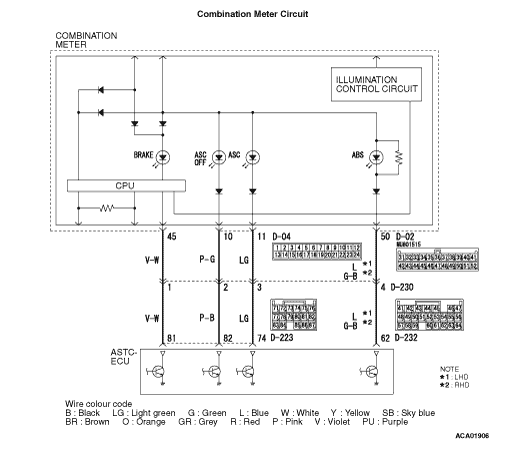
The active stability control indicator lamp illuminates or goes out by the transistor
control inside the ASTC-ECU. In this circuit, when the transistor is ON, the active stability
control indicator lamp illuminates.
|
|
|
The most likely causes for this case are:
|
|
|
- Damaged wiring harness or connector
- Combination meter defect
- Malfunction of the ASTC-ECU
|
|
|
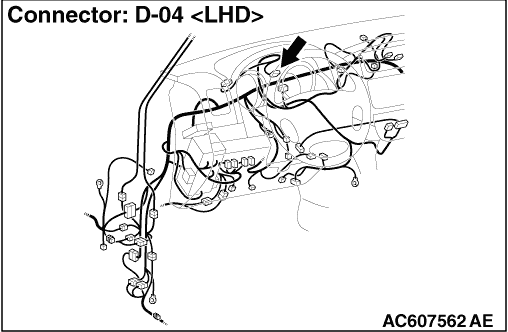
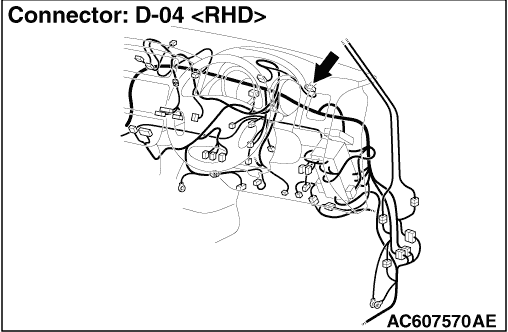
(1)Do not disconnect D-04 combination meter connector, and check at the harness side.
|
|
|
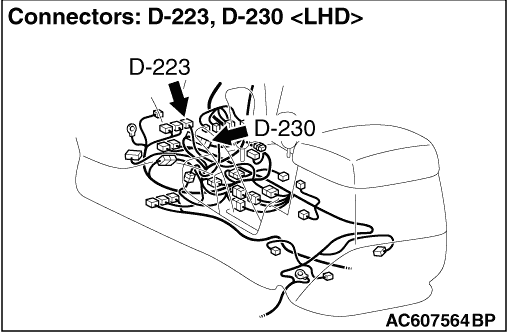
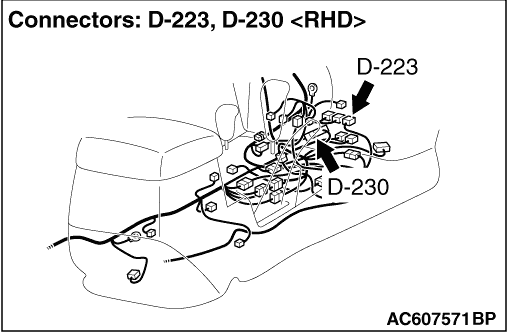
(2)Disconnect D-223 ASTC-ECU connector.
|
|
|
(3)Turn the ignition switch to the "ON" position.
|
|
|
(4)Measure the voltage between terminal 11 and earth.
OK: Approximately system voltage
|
|
|
Q.
Is the check result normal?
|
|
|
Q.
Is the check result normal?
|
|
|
 Repair the defective connector. Then go to Step 5. Repair the defective connector. Then go to Step 5.
|
|
|
|
|
|
Check for short to earth in the wiring harness.
|
|
|
Q.
Is the check result normal?
|
|
|
 Replace the combination meter. Then go to Step 4. Replace the combination meter. Then go to Step 4.
|
|
|
|
|
|
Repair the harness wire. Then go to Step 5.
|
|
|
|
|
|
Q.
After the ignition switch is turned to the "ON" position and the active stability
control indicator lamp has illuminated for 3 seconds, does the lamp go out?
|
|
|
It can be assumed that this malfunction is intermittent. Refer to GROUP 00, How
to Use Troubleshooting/Inspection Service Points - How to Cope with Intermittent
Malfunction  . .
|
|
|
|
|
|
Repair the ASTC-ECU. Then go to Step 5.
|
|
|
|
|
|
Q.
After the ignition switch is turned to the "ON" position and the active stability
control indicator lamp has illuminated for 3 seconds, does the lamp go out?
|
|
|
The procedure is complete.
|
|
|
|