|
|
Use the M.U.T.-III to diagnose the CAN bus lines.
|
|
|
Q.
Is the check result normal?
|
|
|
 Repair the CAN bus line (Refer to GROUP 54D, Diagnosis Repair the CAN bus line (Refer to GROUP 54D, Diagnosis  ). ).
|
|
|
|
|
|
Check again if the diagnosis code is set.
|
|
|
(1)Erase the diagnosis code.
|
|
|
(2)Ignition: "LOCK" (OFF) position to "ON"
|
|
|
(3)On completion, check that the diagnosis code is not reset.
|
|
|
Q.
Is the diagnosis code set?
|
|
|
There is an intermittent malfunction such as poor engaged connector(s) or open circuit (Refer to GROUP 00, How to Cope with Intermittent Malfunction ).
|
|
|
|
|
|
(1)Disconnect the negative battery terminal.
|
|
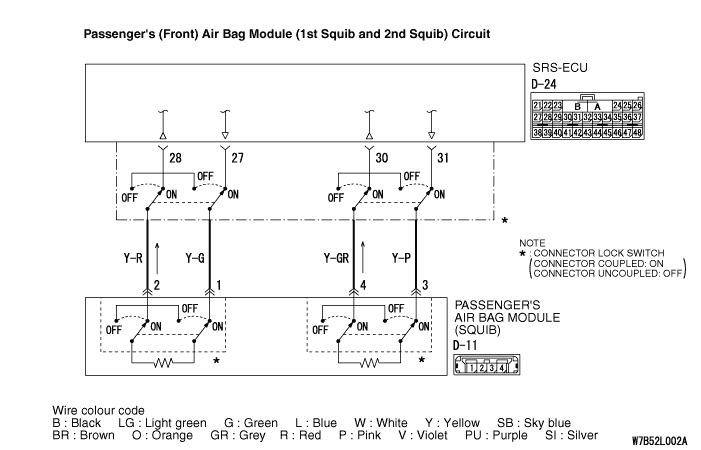
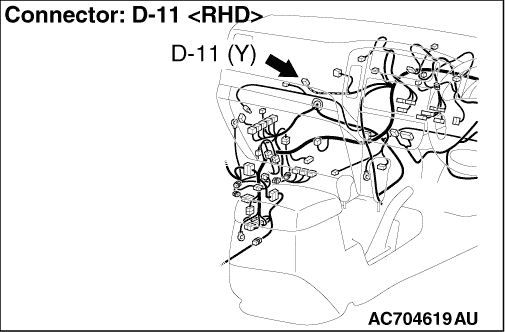
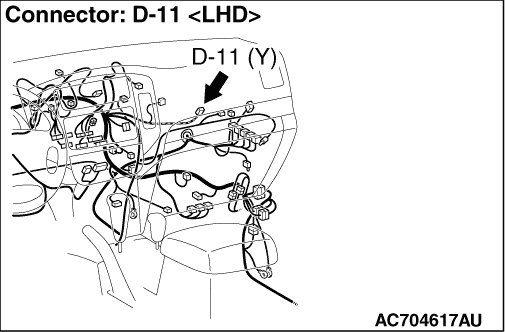
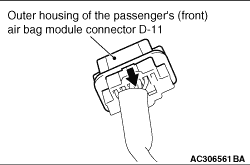
(2)Slide the outer housing of the passenger’s (front) air bag module connector D-11 in the arrow direction shown, and disconnect the connector.
|
|
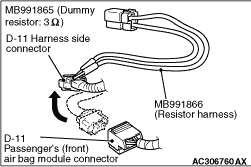
(3)Connect special tool dummy resistor (MB991865) to special tool resistor harness (MB991866).
(4)
| caution |
Do not insert a test probe into the terminal from its front side directly, as the connector contact pressure may be weakened.
|
Insert special tool MB991866 into the harness side connector D-11 (terminal No.1 and 2 <1st squib> or terminal No.3 and 4 <2nd squib>) by backprobing.
(5)Connect the negative battery terminal.
(6)
| caution |
Always diagnosis code B1491 is set when checking diagnosis code B1412. This is because the second side terminal is isolated when checking it, diagnosis code B1491 is set but this is not a fault. In addition, always diagnosis code B1411 is set when checking diagnosis code B1492 because the first side terminal is isolated.
|
Erase the diagnosis code from memory, and check the diagnosis code.
Q.
Is the checked diagnosis code set?
 Go to Step 4. Go to Step 4.
Replace the passenger’s (front) air bag module (Refer to ). Then go to Step 5.
|
|
|
(1)Disconnect the negative battery terminal.
|
|
|
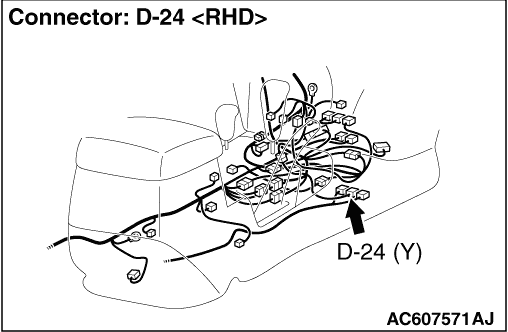
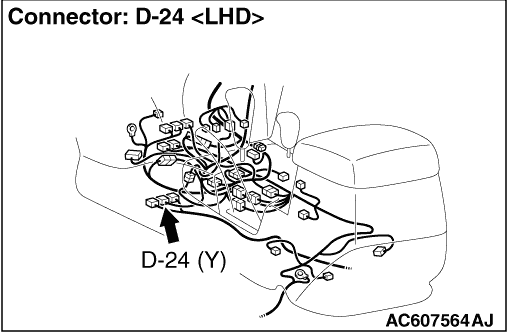
(2)Disconnect SRS-ECU connector D-24.
|
|
(3)
| danger |
To prevent the air bag from deploying unintentionally, disconnect the passenger’s (front) air bag module connector D-11 to short the squib circuit.
|
Slide the outer housing of the passenger’s (front) air bag module connector D-11 in the arrow direction shown, and disconnect the connector.
|
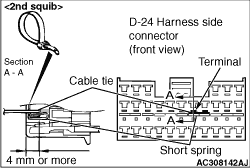
|
(4)
| caution |
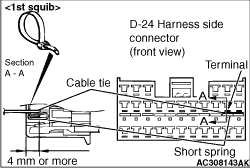
Insert an insulator such as a cable tie to a depth of 4 mm or more, otherwise the short spring will not be released.
|
Insert a cable tie [3 mm wide, 0.5 mm thick] between terminals 27 and 28 <1st squib> or 30 and 31 <2nd squib>, and the short spring to release the short spring.
(5)
| caution |
Do not insert a test probe into the terminal from its front side directly, as the connector contact pressure may be weakened.
|
Check for continuity between D-24 (harness side connector terminals 27, 28 <1st squib> or 30, 31 <2nd squib>) and body earth.
OK: Open circuit
Q.
Is the check result normal?
Erase the diagnosis code from memory, and check the diagnosis code. If diagnosis code B1412 <1st squib> B1492 <2nd squib> sets, replace the SRS-ECU (Refer to ). Then go to Step 5.
Repair the harness wires between SRS-ECU connector D-24 and passenger’s (front) air bag module connector D-11. Then go to Step 5.
|
|
|
Q.
Is diagnosis code B1412 <1st squib> B1492 <2nd squib> set?
|
|
|
The procedure is complete.
|
|
|
|