
|
Air flow sensor is installed in the air intake hose. Air flow sensor is composed of an
extremely small heatsensing resistor. The air flow sensor controls the amount of electric current
flowing into the heat sensing resistor to keep the heat sensing resistor at a constant temperature
to the intake air temperature. When the air mass flow rate increases, the air flow speed is
higher and also the amount of heat transfer from the heat sensing resistor to the air is increased.
Therefore, the air flow sensor increases the amount of electric current to the heat sensing
resistor. Thus, the amount of electric current increases in accordance with the air mass flow
rate. The air flow sensor measures the air mass flow rate by detecting the amount of electric
current. The air flow sensor amplifies the detected electric current amount and outputs it into
the engine-A/T-ECU. Engine-A/T-ECU uses this output current and engine speed to calculate and
decide basic fuel injection time. Sensor properties are as shown in the figure.
|

|
Intake air temperature sensor is built in to the air flow sensor. Intake air temperature
sensor detects intake air temperature through thermistor’s resistance change and outputs
the voltage according to intake air temperature to engine-A/T-ECU. Engine-A/T-ECU uses this
output voltage to compensate fuel injection control and ignition timing control. Sensor properties are
as shown in the figure.
|

|
Manifold absolute pressure sensor is installed in inlet manifold plenum. Manifold absolute
pressure sensor uses a piezo resistive semiconductor to output the voltage according to manifold absolute
pressure to engine-A/T-ECU. Engine-A/T-ECU uses this output voltage to compensate fuel injection
volume according to manifold absolute pressure. Sensor properties are as shown in the figure.
|

|
Engine coolant temperature sensor is installed in the water outlet fitting. Engine coolant
temperature sensor uses thermistor’s resistance change to detect coolant temperature
and output the voltage according to coolant temperature to engine-A/T-ECU. Engine-A/T-ECU uses
this output voltage to appropriately control fuel injection volume, idle speed and ignition
timing. Sensor properties are as shown in the figure.
|

|
The throttle position sensor is installed in the throttle body. Throttle position sensor
outputs voltage to engine-A/T-ECU based on the throttle shaft rotation angle. Engine-A/T-ECU
uses this signal to detect the throttle valve opening angle to perform throttle valve control
servo feedback control. This throttle position sensor uses Hall IC and is of non-contact type.
|

|
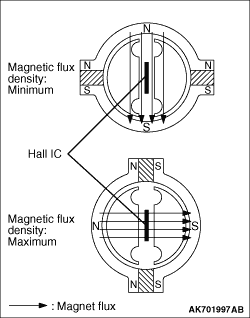
Throttle position sensor is composed of a permanent magnet fixed on the throttle shaft,
Hall IC that outputs voltage according to magnetic flux density and a stator that efficiently
introduces magnetic flux from the permanent magnet to Hall IC.
|
|
Magnetic flux density at Hall IC is proportional to the output voltage.
Throttle position sensor has 2 output systems - throttle position sensor (main)
and throttle position sensor (sub), and the output voltage is output to engine-A/T-ECU. When
throttle valve turns, output voltage of throttle position sensor (main) and throttle position
sensor (sub) changes. This allows engine-A/T-ECU to detect actual throttle opening angle. Engine-A/T-ECU
uses this output voltage for throttle valve control servo feedback control. Also, engine-A/T-ECU compares
output voltage of the throttle position sensor (main) and throttle position sensor (sub) to
check for abnormality in the throttle position sensor. The relationship between throttle opening
angle and output voltage of the throttle position sensor (main) and throttle position sensor
(sub) is as shown in the figure below.
|

|
Accelerator pedal position sensor is integrated with accelerator pedal, and detects accelerator
opening angle. Engine-A/T-ECU uses the output voltage of this sensor to control appropriate
throttle valve opening angle and fuel injection volume. This accelerator pedal position sensor
uses Hall IC and is of non-contact type.
|

|
Accelerator pedal position sensor is composed of a permanent magnet fixed on the magnet
carrier of the pedal shaft, Hall IC that outputs voltage according to magnetic flux density
and a stator that efficiently introduces magnetic flux from the permanent magnet to Hall IC.
|

|
Magnetic flux density at Hall IC is proportional to the output voltage.
The accelerator pedal position sensor has 2 output systems - accelerator pedal
position sensor (main) and accelerator pedal position sensor (sub), and the output voltage is
output to engine-A/T-ECU. According to depression of the accelerator pedal, output voltage of
the accelerator pedal position sensor (main) and accelerator pedal position sensor (sub) changes.
This allows engine-A/T-ECU to detect the actual accelerator pedal depression amount. Engine-A/T-ECU uses
accelerator pedal position sensor (main) output voltage for appropriate throttle valve opening
angle control and fuel injection volume control. Also, engine-A/T-ECU compares output voltage
of the accelerator pedal position sensor (main) and accelerator pedal position sensor (sub)
to check for abnormality in sensor. The relationship between accelerator opening angle and output
voltage of the accelerator pedal position sensor (main) and accelerator pedal position sensor (sub)
is as shown in the figure below.
|

|
Oxygen sensors are installed in 2 positions (front, rear) on both the right bank catalytic
converter and left bank catalytic converter. Oxygen sensor has a built-in heater to help early
activation of the sensor. This allows feedback control of air-fuel ratio soon after start.
|

|
This sensor uses the oxygen concentration cell principle of solid electrolyte (zirconia)
and displays the property of sudden change in output voltage near theoretical air-fuel ratio.
This property is used to detect oxygen density in exhaust gas. Feedback to engine-A/T-ECU allows
it to judge whether air-fuel ratio is rich or lean compared to theoretical air-fuel ratio.
|

|
This allows engine-A/T-ECU precise feedback control to get theoretical air-fuel ratio
with best cleaning efficiency of 3-way catalytic converter.
|

|
A crank angle sensor is installed on the oil pump case. The crank angle sensor monitors
rotation of crankshaft sensing blade (36 teeth including 4 missing teeth) installed on the crankshaft
and converts to voltage (pulse signal) that is output to engine-A/T-ECU. Engine-A/T-ECU uses
crank angle sensor’s output pulse to detect crank angle.
|

|
The crank angle sensor uses a magnetic resistance element. When the vane of the crankshaft-sensing
blade passes the front surface of the magnetic resistance element, the flux from the magnet passes
the magnetic resistance element. Thus, resistance of the magnetic resistance element increases.
When the vane of the crankshaft-sensing blade does not pass the front surface of the magnetic
resistance element, the flux from the magnet does not pass the magnetic resistance element and
the resistance decreases. The crank angle sensor converts this change in resistance of the magnetic
resistance element to a 5 V pulse signal and outputs it to engine-A/T-ECU.
|

|
A camshaft position sensor is installed on the cylinder head on left bank side. The camshaft
position sensor monitors rotation of the camshaft position-sensing cylinder (7 teeth) and converts
to voltage (pulse signal) that is output to engine-A/T-ECU. Engine-A/T-ECU uses a combination
of the camshaft position sensor output pulse signal and crank angle sensor output pulse signal
to identify cylinders in the compression process.
|

|
The camshaft position sensor uses a magnetic resistance element. When the vane of the
camshaft position-sensing cylinder passes the front surface of the magnetic resistance element, the
flux from the magnet passes the magnetic resistance element. Thus, the resistance of the magnetic
resistance element increases. When the vane of the camshaft position-sensing cylinder does not
pass the front surface of the magnetic resistance element, the flux from the magnet does not
pass to magnetic resistance element and resistance decreases. The camshaft position sensor converts
this change in resistance of the magnetic resistance element to a 5 V pulse signal and outputs
the signal to engine-A/T-ECU.
|

|
A detonation sensor is installed with detonation sensor bracket on the cylinder block.
Detonation sensor uses the piezo electric element to convert the vibration of the cylinder block
generated when engine is in operation to minute voltage that is output to engine-A/T-ECU. Engine-A/T-ECU
uses the minute output voltage from the detonation sensor filtered through the cylinder block’s
natural frequency to detect knocking, and compensates the ignition timing lag according to the
strength of the knocking.
|

|
A barometric pressure sensor is built into engine-A/T-ECU. The barometric pressure sensor
is a semiconductor diffused pressure element which outputs voltage to engine-A/T-ECU according
to atmospheric pressure. Engine-A/T-ECU uses this output voltage to sense the altitude of the
vehicle and compensates fuel injection volume to get the appropriate air-fuel ratio for that altitude.
|

|
A vehicle speed sensor is installed in the transfer. The vehicle speed sensor uses a magnetic
resistance element. The vehicle speed sensor monitors rotation of the rotor installed on the
output shaft and converts to voltage that is output to engine-A/T-ECU. Engine-A/T-ECU calculates
vehicle speed based on the vehicle speed sensor’s output frequency. Sensor properties
are as shown in the figure.
|

|
A power steering fluid pressure switch is installed on the power steering oil pump. The
power steering fluid pressure switch uses a contact switch to detect the power steering fluid
pressure. When power steering oil pressure rises due to operation of the steering wheel, the
power steering load switch outputs an ON signal to engine-A/T-ECU. When this signal is input,
engine-A/T-ECU performs idle-up and prevents reduction in engine speed due to power steering
load and so maintains stable idle speed.
|
|
|
Alternator turns ON/OFF the power transistor in the voltage regulator to adjust current
flow in the field coil according to alternator output current. In this way alternator’s output
voltage is kept adjusted (to about 14.7 V). The ratio of power transistor ON time (ON duty)
is output from alternator FR terminal to engine-A/T-ECU. Engine-A/T-ECU uses this signal to
detect alternator’s output current and drives throttle valve control servo according
to output current (electric load). This prevents change in idle speed due to electric load and
helps maintain stable idle speed.
|


