|
|
When discarding the air bag modules or a vehicle with SRS air bags, be sure to deploy
the air bags in advance as specified in the service procedure that follows.
|
|
|
1.Move the vehicle to flat and isolated spot.
|
|
|
2.
| caution |
Disconnect the auxiliary battery cable connection, and wait
for 60 seconds or more before starting the work.
|
Disconnect the (-) and (+) terminals of auxiliary battery cable, and
then remove the auxiliary battery from the vehicle.
|
|
|
3.Remove the column cover lower (Refer to GROUP 37, Steering shaft  ). ).
|

|
4.Remove the connection between the clock spring connector (4-pin) and the harness side
connector (4-pin).
| note |
Once disconnected from the instrument panel wiring harness, both electrodes of the clock
spring connector short automatically. This prevents the driver’s air bag from accidental
deployment caused by static, etc.
|
|
|
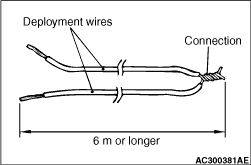
5.Obtain two suitable wires, which are 6 meters or longer, as deployment wires. Then connect
the wires at one end to short.
6.Touch the vehicle’s body with bare hands to discharge static in you.
|

|
7.Cut with a pliers, etc. the instrument panel wiring harness shown in the figure of the
instructions, while the clock spring connector is disconnected.
| note |
The disconnection location should be sufficiently away from the harness side connector
with consideration to the expansion harness connection location upon disconnections.
|
8.Connect the deployment wires on the two instrument panel wiring harnesses disconnected,
cover the connection areas with insulator tape and then pull out the deployment wires outside
the vehicle.
9.Connect the harness side connector connected with an expansion harness to the clock
spring connector.
|

|
10.
| warning |
If the glass is scratched, the glass may be shattered at deployment. Therefore, cover
with a vehicle cover to avoid danger.
|
In order to suppress the operation sound as much as possible, fully close all the door
windows, close the doors, and then cover the vehicle with a vehicle cover.
11.
| caution |
- Make sure that no one
is present inside or near the vehicle before deploying the air bag.
- Immediately after the air bag deployment, the inflator is extremely hot. Thus, before
handling, leave the inflator for 30 minutes or more to cool.
- If the air bag module does not deploy, consult with your distributor.
|
Disconnect the deployment wire connection at a place as far as possible from the vehicle.
Then, connect the wires to the removed vehicle auxiliary battery to deploy the air bag module.
12.Discard the deployed air bag module according to the disposal procedures. (Refer to
.)
|
|
|
1.Move the vehicle to flat and isolated spot.
|
|
|
2.Disconnect the (-) and (+) terminals of auxiliary battery cable,
and then remove the auxiliary battery from the vehicle.
|
|
|
3.Remove the glove box (Refer to ).
|

|
4.Release the claw (1) of the lock lever of the front passenger’s air bag module
harness side connector, and lift the lock lever to the direction of the arrow (2), then remove the
connector.
| note |
Once disconnected from the instrument panel wiring harness, both electrodes of the passenger’s
(front) air bag module short automatically. This prevents the passenger’s (front) air
bag from accidental deployment caused by static, etc.
|
|

|
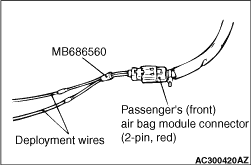
5.Connect deployment wires longer than 6 m to each SRS air bag adapter harness (MB686560)
and insulate the connections with insulator tape. Also, connect the deployment wires in the
other ends to short, thereby preventing the passenger’s (front) air bag from accidental deployment
caused by static etc.
|
|
6.Connect the passenger’s (front) air bag module connector (2-pin, red) to special
tool SRS air bag adapter harness (MB686560) and move the deployment wires out of the vehicle.
|
|
7.
| warning |
If the glass is scratched, the glass may be shattered at deployment. Therefore, cover
with a vehicle cover to avoid danger.
|
In order to suppress the operation sound as much as possible, fully close all the door
windows, close the doors, and then cover the vehicle with a vehicle cover.
8.
| caution |
- Make sure that no one
is present inside or near the vehicle before deploying the air bag.
- Immediately after the air bag deployment, the inflator is extremely hot. Thus, before
handling, leave the inflator for 30 minutes or more to cool.
- If the air bag module does not deploy, consult with your distributor.
|
Disconnect the deployment wire connection at a place as far as possible from the vehicle.
Then, connect the wires to the removed vehicle auxiliary battery to deploy the air bag module.
9.Discard the deployed air bag module according to the disposal procedures. (Refer to
.)
|
|
|
1.Move the vehicle to flat and isolated spot.
|
|
|
2.Disconnect the (-) and (+) terminals of auxiliary battery cable,
and then remove the auxiliary battery from the vehicle.
|

|
3.Disconnect the connections of the side-airbag module connector and the harness side connector.
| caution |
Make sure to deploy both driver’s and front passenger’s side-airbags.
|
| note |
When the side-airbag module connector is disconnected from the harness side connector,
the two pins of side-airbag module connector are automatically shorted. This prevents the unintentional
deployment of side-airbags caused by the static or others.
|
|

|
4.Prepare two deployment wires of 6 m or more, and keep the terminal at one end connected
to that of the other wire (shorted).
| note |
This prevents the air bags from unintentional deployment caused by static.
|
5.
| caution |
The following procedures are intended to prevent the unintentional
deployment caused by the static. Therefore, make sure to perform the procedures.
|
Touch the vehicle body with bare hands to release the charged static.
|

|
6.With the side-airbag module connector disconnected, cut the harness side connector using
a nipper or similar tools.
7.Connect the deployment wire to each of two cut wiring harnesses. After covering the
connection areas with insulation tape, pull out the deployment wire to outside the vehicle.
8.Connect the harness side connector, to which the deployment wire is connected, to
the side-airbag module connector.
|
|
9.
| warning |
If the glass is scratched, the glass may be shattered at deployment. Therefore, cover
with a vehicle cover to avoid danger.
|
In order to suppress the operation sound as much as possible, fully close all the door
windows, close the doors, and then cover the vehicle with a vehicle cover.
10.
| caution |
- Make sure that no one
is present inside or near the vehicle before deploying the air bag.
- Immediately after the air bag deployment, the inflator is extremely hot. Thus, before
handling, leave the inflator for 30 minutes or more to cool.
- If the air bag module does not deploy, consult with your distributor.
|
Disconnect the deployment wire connection at a place as far as possible from the vehicle.
Then, connect the wires to the removed vehicle auxiliary battery to deploy the side-airbag module.
11.Discard the deployed air bag module according to the disposal procedures. (Refer to
.)
|
|
|
1.Move the vehicle to flat and isolated spot.
|
|
|
2.Disconnect the (-) and (+) terminals of auxiliary battery cable,
and then remove the auxiliary battery from the vehicle.
|
|
|
3.Remove the headlining (Refer to GROUP 52A - Headlining ).
|

|
4.Use the flat-tipped screwdriver to pull out the locking button of harness side connector.
After releasing the lock, disconnect the connector.
| note |
When the harness side connector is disconnected from the inflator, the two pins of inflator
connector are automatically shorted. This prevents the unintentional deployment of curtain air
bags caused by the static or others.
|
|

|
5.Connect the deployment wires of 6 m or more to each of the two wiring harnesses of special
tool adapter harness (MB661885), and cover the connection areas with insulation tape. Keep the
other ends of deployment wires connected to each other (shorted).
| note |
This prevents the unintentional deployment of curtain air bags caused by the static or
others.
|
|

|
6.Connect the adapter harness to the inflator, and then pull out the deployment wire to
outside the vehicle.
|
|
7.
| warning |
If the glass is scratched, the glass may be shattered at deployment. Therefore, cover
with a vehicle cover to avoid danger.
|
In order to suppress the operation sound as much as possible, fully close all the door
windows, close the doors, and then cover the vehicle with a vehicle cover.
8.
| caution |
- Make sure that no one
is present inside or near the vehicle before deploying the air bag.
- Immediately after the air bag deployment, the inflator is extremely hot. Thus, before
handling, leave the inflator for 30 minutes or more to cool.
- If the air bag module does not deploy, consult with your distributor.
|
Disconnect the deployment wire connection at a place as far as possible from the vehicle.
Then, connect the wires to the removed vehicle auxiliary battery to deploy the air bag module.
9.Discard the deployed air bag module according to the disposal procedures. (Refer to
.)
|
|
|
1.
| caution |
Disconnect the auxiliary battery cable connection, and wait
for 60 seconds or more before starting the work.
|
Disconnect the (-) and (+) terminals of auxiliary battery cable, and
then remove the auxiliary battery from the vehicle.
|
|
|
2.
| caution |
When the connector is disconnected, the four pins of
air bag module are automatically shorted to prevent the unintentional deployment caused by the
static or others. However, in preparation for the accidental deployment, store the air bag module
on a flat place with the deployment surface facing upward. Also, do not put anything on it.
|
Remove the driver’s air bag module from the vehicle (Refer to ).
|
|
3.Obtain two suitable wires, which are 6 meters or longer, as deployment wires. Then connect
the wires at one end to short.
4.Touch the vehicle’s body with bare hands to discharge static in you.
|

|
5.Using pliers, cut the driver’s air bag module connector from the harnesses. Connect
the deployment wires to each harness that has been cut and insulate the connections with plastic
tape.
6.To the torx screw installation hole located at the backside of air bag module, tie
a thick wire for fixing the wheel.
|

|
7.Pass the deployment wire connected to the air bag module underneath the old tyre with
wheel. Then, fix the air bag module with deployment surface facing upward using the wire which
is tied to the bolt.
|

|
8.Place three old tyres without wheel onto the tyre to which the air bag module is fixed.
|

|
9.
| caution |
- Make sure that no one is present near the air bag module
before deploying the air bag.
- Immediately after the air bag deployment, the inflator is extremely hot. Thus, before
handling, leave the inflator for 30 minutes or more to cool.
- If the air bag module does not deploy, consult with your distributor.
|
Disconnect the deployment wire connection at a place as far as possible from the air bag
module. Then, connect the wires to the removed vehicle auxiliary battery to deploy the air bag
module.
10.Discard the deployed air bag module according to the disposal procedures. (Refer to
.)
|
|
|
1.
| caution |
Before starting the work, wait for 60 seconds or more
after the disconnection of the auxiliary battery cable. (Refer to the item 5 of
Service Precautions.)
|
Disconnect the (-) and (+) terminals of auxiliary battery cable, and
then remove the auxiliary battery from the vehicle.
|
|
|
2.
| caution |
When the connector is disconnected, the four pins of
air bag module are automatically shorted to prevent the unintentional deployment caused by the
static or others. However, in preparation for the accidental deployment, store the air bag module
on a flat place with the deployment surface facing upward. Also, do not put anything on it.
|
Remove the passenger’s (front) air bag module from the vehicle (Refer to ).
|
|
3.Connect deployment wires longer than 6 m to each SRS air bag adapter harness (MB686560)
and insulate the connections with insulator tape. Also, connect the deployment wires in the
other ends to short, thereby preventing the passenger’s (front) air bag from accidental deployment
caused by static etc.
4.Connect the adapter harness to the passenger’s (front) air bag module.
|

|
5.Pass a thick wire through the hole of air bag module bracket. Then, with the air bag module
deployment surface facing upward, fix the module to the old tyre with wheel.
|

|
6.Place three old tyres without wheel onto the tyre to which the air bag module is fixed.
Then, tie and fix all the tyres with rope (4 positions).
| note |
The passenger’s (front) air bag has a larger deployment volume than the driver’s
air bag. Therefore, it is necessary to tie the tyres with rope.
|
|

|
7.
| caution |
- Make sure that no one is
present near the air bag module before deploying the air bag.
- Immediately after the air bag deployment, the inflator is extremely hot. Thus, before
handling, leave the inflator for 30 minutes or more to cool.
- If the air bag module does not deploy, consult with your distributor.
|
Disconnect the deployment wire connection at a place as far as possible from the air bag
module. Then, connect the wires to the removed vehicle auxiliary battery to deploy the air bag
module.
8.Discard the deployed air bag module according to the disposal procedures. (Refer to
.)
|
|
|
1.
| caution |
Before starting the work, wait for 60 seconds or more
after the disconnection of the auxiliary battery cable (Refer to the item 5 of
Service Precautions).
|
Disconnect the (-) and (+) terminals of auxiliary battery cable, and
then remove the auxiliary battery from the vehicle.
|
|
|
2.
| caution |
When the connector is disconnected, the two pins of side air
bag module are automatically shorted to prevent the unintentional deployment caused by the static
or others. However, in preparation for the accidental deployment, store the air bag module on
a flat place with the deployment surface facing upward. Also, do not put anything on it.
|
Remove the front seatback frame (Refer to ).
|
|
|
3.Remove the side-airbag module from the front seatback frame.
|
|
4.Prepare two deployment wires of 6 m or more, and keep the terminal at one end connected
to that of the other wire (shorted).
| note |
This prevents the air bags from unintentional deployment caused by static.
|
5.
| caution |
The following procedures are intended to prevent the unintentional
deployment caused by the static. Therefore, make sure to perform the procedures.
|
Touch the vehicle body with bare hands to release the charged static.
|

|
6.Cut off the side-airbag module connector from the wiring harness with nippers. Individually
connect a harness on the two harnesses disconnected, cover the connection areas with insulation
tape.
|

|
7.Pass the deployment wire connected to the side-airbag module underneath the old tyre with
wheel. Then, fix the air bag module with deployment surface facing upward using the wire which
is tied to the bolt.
|

|
8.Place three old tyres without wheels on top of the tyre secured to the air bag module,
and secure all tyres together with ropes (four locations).
|
|
9.
| caution |
- Make sure that no one is
present near the air bag module before deploying the air bag.
- Immediately after the air bag deployment, the inflator is extremely hot. Thus, before
handling, leave the inflator for 30 minutes or more to cool.
- If the inflator does not activate, consult with your distributor.
|
Disconnect the deployment wire connection at a place as far as possible from the air bag
module. Then, connect the wires to the removed vehicle auxiliary battery to deploy the air bag
module.
10.Discard the deployed air bag module according to the disposal procedures. (Refer to
.)
|
|
|
1.
| caution |
Disconnect the auxiliary battery cable connection, and wait
for 60 seconds or more before starting the work.
|
Disconnect the (-) and (+) terminals of auxiliary battery cable, and
then remove the auxiliary battery from the vehicle.
|
|
|
2.
| caution |
When the connector is disconnected, the two pins of air bag
module are automatically shorted to prevent the unintentional deployment caused by the static
or others. However, in preparation for the accidental deployment, store the air bag module on
a flat place with the deployment surface facing upward. Also, do not put anything on it.
|
Remove the curtain air bag module (Refer to ).
|

|
3.Cut the inflator from the air bag as shown in the figure using a cutter or a similar tool.
|
|
4.Connect the deployment wires of 6 m or more to each of the two wiring harnesses of special
tool adapter harness (MB991885), and cover the connection areas with insulation tape. Keep the
other ends of deployment wires connected to each other (shorted).
| note |
This prevents the unintentional activation of inflator caused by the static or others.
|
|

|
5.Feed a thick wire through the bracket of the inflator, and connect it to an old tyre with
a wheel.
6.Connect the adapter harness to the inflator connector.
|
|
7.Place the tyre to which the inflator is fixed onto the two stacked tyres. Then, place
1 or more old tyres without wheel onto the stacked tyres, and tie and fix all the tyres with
rope. (4 positions)
|
|
8.
| caution |
- Make sure that no one is
present near the inflator before the activation.
- Immediately after the inflator activation, the inflator is extremely hot. Thus,
before handling, leave the inflator for 30 minutes or more to cool.
- If the inflator does not activate, consult with your distributor.
|
Disconnect the deployment wire connection at a place as far as possible from the inflator.
Then, connect the wires to the removed vehicle auxiliary battery to activate the inflator.
9.Discard the activated inflator according to the disposal procedures (Refer to ).
|
|
|
After deployment and operation, the air bag module and seat belt pre-tensioner should
be disposed of in the same manner as any other scrap parts, adhering to local laws and/or legislation.
Observe the following precautions during air bag or seat belt pre-tensioner disposal:
|
|
|
1.Immediately after the air bag deployment, the inflator is extremely hot. Thus, before
handling, leave the inflator for 30 minutes or more to cool.
|
|
|
2.Do not pour water or oil onto the deployed air bag module.
|
|
|
3.To the deployed air bag module, substances that irritate eyes and skin may be deposited.
Therefore, wear gloves and protective glasses when handling the module. When the substance comes
in contact with eyes or skin, flush with a large amount of water.
|
|
|
4.Place the air bag module in the sturdy plastic bag, and seal the bag for disposal.
|
|
|
5.After the work, be sure to wash your hands with water.
|