Inspection Procedure 5: Intake Air Temperature Sensor System
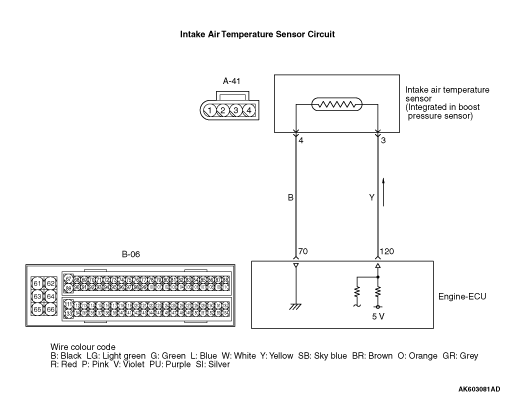

OPERATION
- A power voltage of 5 V is applied to the intake air temperature
sensor output terminal (terminal No. 3) from the engine-ECU (terminal No. 120).
- The power voltage is earthed to the engine-ECU (terminal No. 70) from the intake
air temperature sensor (terminal No. 4).
FUNCTION
- The intake air temperature sensor converts the intake
air temperature into a voltage signal, and inputs the voltage to the engine-ECU.
- In response to the signal, the engine-ECU controls the fuel injection quantity and
the boost pressure control.
- The intake air temperature sensor is a kind of resistor, which has characteristics
to reduce its resistance as the intake air temperature rises. Therefore, the sensor output voltage
varies with the intake air temperature, and becomes lower as the intake air temperature rises.
PROBABLE CAUSE
- Failed intake air temperature sensor
- Open/short circuit or harness damage in intake air temperature sensor circuit or
loose connector contact
- Failed engine-ECU
DIAGNOSIS PROCEDURE |
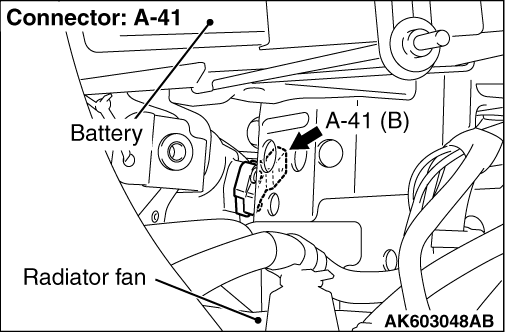
STEP 1. Connector check: A-41 boost pressure sensor connector |
Q.
Is the check result normal?
|
 Go to Step 2 . Go to Step 2 . |
|
 Repair or replace the connector. Repair or replace the connector. |
|
STEP 2. Perform resistance measurement at A-41 boost pressure sensor connector. |
|
| OK: Continuity (2 Ω or less) |
Q.
Is the check result normal?
|
| Go to Step 6 . |
|
| Go to Step 3 . |
|
STEP 3. Connector check: B-06 engine-ECU connector |
Q.
Is the check result normal?
|
| Go to Step 4 . |
|
| Repair or replace the connector. |
|
STEP 4. Check harness between A-41 (terminal No. 4) boost pressure sensor connector and B-06 (terminal No. 70) engine-ECU connector. |
|
Q.
Is the check result normal?
|
| Go to Step 5 . |
|
| Repair the damaged harness wire. |
|
STEP 5. Check the trouble symptoms. |
Q.
Does trouble symptom persist?
|
| Replace the engine-ECU. |
|
Intermittent malfunction (Refer to GROUP 00 - How to Use Troubleshooting/Inspection
Service Points - How to Cope with Intermittent Malfunctions  ). ). |
|
STEP 6. Perform voltage measurement at A-41 boost pressure sensor connector. |
|
| OK: 4.5 - 4.9 V |
Q.
Is the check result normal?
|
| Go to Step 11 . |
|
| Go to Step 7 . |
|
STEP 7. Perform voltage measurement at B-06 engine-ECU connector. |
|
| OK: 4.5 - 4.9 V |
Q.
Is the check result normal?
|
| Go to Step 8 . |
|
| Go to Step 9 . |
|
STEP 8. Connector check: B-06 engine-ECU connector |
Q.
Is the check result normal?
|
|
|
| Repair or replace the connector. |
|
STEP 9. Connector check: B-06 engine-ECU connector |
Q.
Is the check result normal?
|
| Go to Step 10 . |
|
| Repair or replace the connector. |
|
STEP 10. Check harness between A-41 (terminal No. 3) boost pressure sensor connector and B-06 (terminal No. 120) engine-ECU connector. |
|
Q.
Is the check result normal?
|
| Go to Step 5 . |
|
| Repair the damaged harness wire. |
|
STEP 11. Connector check: B-06 engine-ECU connector |
Q.
Is the check result normal?
|
| Go to Step 12 . |
|
| Repair or replace the connector. |
|
STEP 12. Check harness between A-41 (terminal No. 3) boost pressure sensor connector and B-06 (terminal No. 120) engine-ECU connector. |
|
Q.
Is the check result normal?
|
| Go to Step 13 . |
|
| Repair or replace the connector. |
|
STEP 13. Replace the boost pressure sensor. |
|
Q.
Does trouble symptom persist?
|
| Replace the engine-ECU. |
|
| The check is end. |
|