|
|
Item 41: Transfer shift lever position (Refer to data list reference table  ). ).
|
|
|
Q.
Is the check result normal?
|
|
|
 Intermittent malfunction (Refer to GROUP 00 - How to Cope with Intermittent Malfunction ). Intermittent malfunction (Refer to GROUP 00 - How to Cope with Intermittent Malfunction ).
|
|
|
|
|
|
Q.
Is the check result normal?
|
|
|
 Replace the transfer shift lever switch (Refer to ). Replace the transfer shift lever switch (Refer to ).
|
|
|
|
|
|
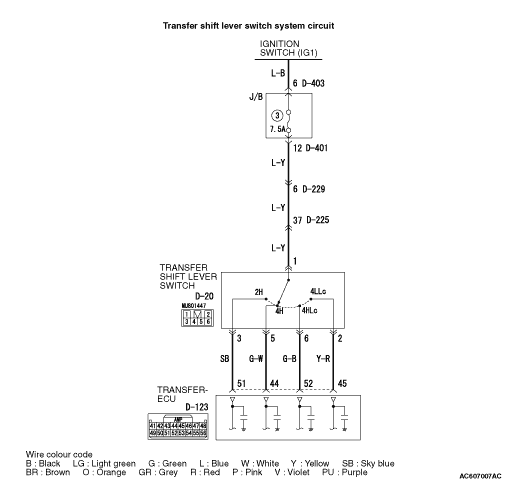
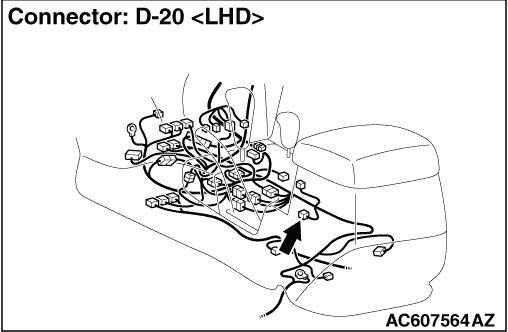
(1)Disconnect the connector, and measure the voltage between terminal No.1 and earth at the wiring harness side.
|
|
|
(2)Turn the ignition switch to the ON position.
OK: System voltage
|
|
|
Q.
Is the check result normal?
|
|
|
Check for the contact with terminals.
|
|
|
Q.
Is the check result normal?
|
|
|
Repair the defective connector.
|
|
|
|
|
|
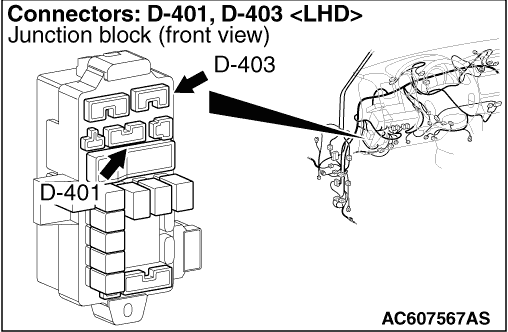
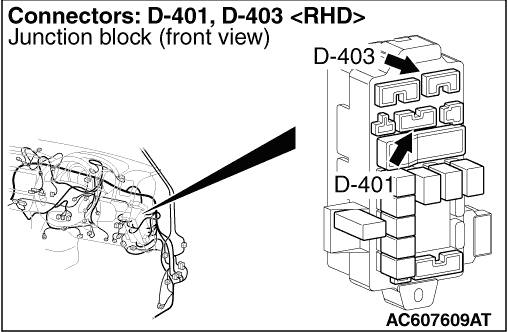
Check the power supply line for short or open circuit.
|
|
|
Q.
Is the check result normal?
|
|
|
Repair the wiring harness.
|
|
|
|
|
|
(1)Connect the transfer shift lever switch connector D-20.
|
|
|
(2)Turn the ignition switch to the ON position.
|
|
|
(3)Disconnect the D-123 transfer-ECU connector, and measure the voltage between the following terminals.
- No.51 and body earth (Transfer shift lever position: 2H)
- No.44 and body earth (Transfer shift lever position: 4H)
- No.52 and body earth (Transfer shift lever position: 4HLc)
- No.45 and body earth (Transfer shift lever position: 4LLc)
OK: System voltage
|
|
|
Q.
Is the check result normal?
|
|
|
Check for the contact with terminals.
|
|
|
Q.
Is the check result normal?
|
|
|
Repair the defective connector.
|
|
|
|
|
|
Check the output line for short or open circuit.
|
|
|
Q.
Is the check result normal?
|
|
|
Repair the wiring harness.
|
|
|
|
|
|
Check for the contact with terminals.
|
|
|
Q.
Is the check result normal?
|
|
|
Repair the defective connector.
|
|
|
|
|
|
Item 41: Transfer shift lever position (Refer to data list reference table ).
|
|
|
Q.
Is the check result normal?
|
|
|
Intermittent malfunction (Refer to GROUP 00 - How to Cope with Intermittent Malfunction ).
|
|
|
|
|
|
Replace the transfer-ECU.
|
|
|
|